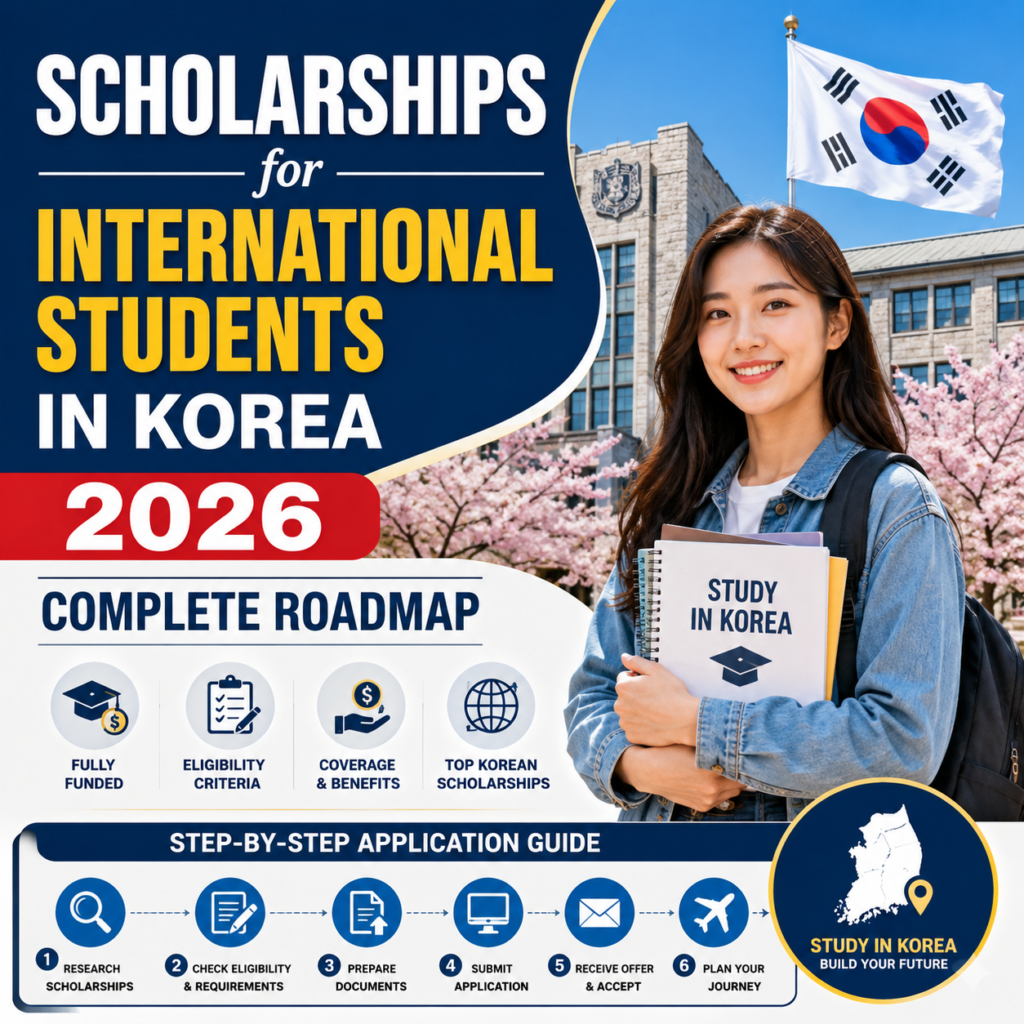
South Korea is no longer just a cultural powerhouse; it’s rapidly becoming one of the world’s most attractive study destinations for international students. And here’s a fact that might surprise you: every year, the South Korean government and its top universities set aside hundreds of millions of dollars specifically to bring ambitious foreign students into their classrooms.
Yes, you read that right. A scholarship for international students in South Korea is not a rare miracle; it’s a well-structured, accessible system—if you know where to look and how to apply.
Maybe you’re drawn to the tech corridors of KAIST, the humanities legacy of Korea University, or the global business programs in Seoul. But your biggest worry isn’t grades or visas—it’s money. You keep asking yourself valid questions like: How do I afford tuition, housing, and living costs in a new country? That’s exactly where scholarships for international students in Korea come in, and this guide is designed to walk you through every single opportunity, strategy, and hidden detail.
By the end of this comprehensive resource, you’ll understand:
- Which government, university, and private scholarships actually deliver full funding
- The exact South Korea scholarship types that match your academic level and nationality
- How to craft a winning application for a Korea University Scholarship and other top programs
- Realistic eligibility requirements, deadlines, and insider tips
- Common mistakes that get applications rejected—and how to avoid them
No vague promises. Just a deeply human, practical, and up-to-date roadmap to funding your Korean education dream in 2026.
Why Korea Invests So Heavily in International Student Scholarships
Before going into the names and numbers, it’s important we understand why these scholarships exist. South Korea’s government and universities are actively internationalising their campuses to attract foreign talents. They want diverse perspectives, global networks, and talented minds who will become bridges between Korea and the world. As a result, fully funded scholarships in South Korea for international students are not just charity—they’re strategic investments. And you can position yourself as exactly the kind of investment they’re looking for.
We have earlier reviewed the Easy Steps to Get a Korean Student Visa which walks you through the application process on how to get your student visa approved. On the other hand, this article focuses on the scholarships opportunities for international students in Korea.
With multiple funding opportunities in Korea, there are different types of scholarships available, and that is what we will discuss in the next section.
Types of Scholarships for International Students in Korea
To make sense of the opportunities, let’s group them into three main buckets: government-funded, university-specific, and external or private scholarships. Most students find their best chance lies in a combination.
1. Government-Funded Scholarships
These are the heavy hitters, often covering full tuition, round-trip airfare, monthly living stipends, Korean language training, and health insurance. The most famous in this category is the Global Korea Scholarship (GKS), formerly known as KGSP. It’s the flagship fully funded scholarship in South Korea for international students offered by the Korean government.
2. University-Specific Scholarships
Almost every major Korean university runs its own scholarship programs for international students, aside the government-funded scholarships. These include the prestigious Korea University Scholarship, Yonsei’s Underwood International College scholarships, KAIST’s full funding packages, and countless others. They often target merit, need, or specific regions.
3. Private and Foundation Scholarships
Organisations like the Samsung Foundation, POSCO, and the Hyundai Foundation also sponsor international students, though these are often tied to specific fields or graduate research.
In the sections ahead, we’ll explore each category in detail, starting with the one most students ask about first: the GKS scholarship.
The Global Korea Scholarship (GKS)
| Category | Key Details |
|---|---|
| What it covers | Full tuition, round-trip airfare, monthly living allowance (approx. 900,000 KRW for undergraduates), a one-time settlement allowance, 1 year of Korean language training, and medical insurance |
| Who can apply | International students from most developing countries and many others; must be in good health, meet age limits (typically under 25 for undergraduate, under 40 for graduate), and hold a high school diploma or equivalent |
| Application tracks | Embassy track – apply through the Korean embassy in your home country. University track – apply directly to a participating Korean university, which then recommends you to NIIED |
| Official information | Full application guidelines, eligibility updates, and notices are published on the official Study in Korea website: www.studyinkorea.go.kr |
When people search for fully funded scholarships in South Korea for international students, the name that comes up most is the Global Korea Scholarship, or GKS. It’s the Korean government’s flagship program, and for good reason. Here’s a clear snapshot of what it really offers.
The GKS isn’t just a tuition waiver opportunity—it’s a complete funding package that is designed to remove financial stress completely. You’ll have your flight, studies, language training, and monthly living costs covered from day one. The one-year Korean language course is mandatory unless you already have a high TOPIK score, so the scholarship builds your language foundation before your degree even begins. If you’re coming from a country with a weaker passport or limited study-abroad funding, GKS is often the single most realistic path to a degree in South Korea.
Korea University Scholarship
| Category | Key Details |
|---|---|
| What it covers | Undergraduate: Full tuition for up to 8 semesters, with a monthly stipend for select recipients.
Graduate: Full tuition for 4 semesters (master’s) or 6 semesters (PhD), often paired with a research stipend if you work as a research assistant. Additional need-based and academic achievement awards are also available for enrolled students. |
| Who can apply | International students applying for undergraduate or graduate degree programs. Selection is based on academic excellence, personal statement strength, recommendation letters, and your potential to contribute to the KU community. There is no single citizenship restriction, but you must hold non-Korean nationality. |
| Application process | Most scholarships are evaluated alongside your admission application—some automatically, some requiring a separate scholarship form. Check the specific scholarship’s requirements on the official website. Early admission rounds often offer the best chance for major awards. |
| Official information | Full scholarship listings, eligibility details, and application guides are available at the Korea University Office of International Affairs: oia.korea.edu |
The term “Korea University Scholarship” actually covers a family of awards rather than a single program. That’s an advantage—it means there are multiple doors in. Whether you’re a high-achieving undergraduate applicant or a graduate student with a strong research proposal, there is likely a specific scholarship bucket waiting for you. The key is understanding that KU doesn’t just look at grades. They look for a story. A genuine, well-articulated explanation of why Korea University is the right academic home for you and how you’ll enrich the campus.
Other Top University Scholarships for International Students in South Korea
A South Korea scholarship doesn’t stop at GKS or KU. Here are other standout programs you should seriously consider:
- Seoul National University (SNU) – SNU Global Scholarship: Covers full tuition and living expenses for select graduate students, plus undergraduate tuition waivers for top applicants.
- KAIST International Student Scholarship: All admitted international graduate students automatically receive a full tuition waiver and a monthly stipend (around 400,000–900,000 KRW depending on program). Undergraduates can also get full tuition and living support based on merit.
- Yonsei University – Underwood International College Scholarships: Multiple tiers from half to full tuition for outstanding global applicants, plus need-based options.
- POSTECH International Student Scholarship: Like KAIST, full tuition and living stipend for graduate students.
- Ewha Womans University – Ewha Global Partnership Program: Full tuition, on-campus housing, and a stipend for female students from developing countries.
- Hanyang University International Scholarship: Up to 100% tuition reduction based on language proficiency and academic record.
Each of these represents a legitimate scholarship for international students in South Korea, and many operate on a rolling or early admission basis. The earlier you apply, the better your chances.
How to Search for Fully Funded Scholarships in South Korea
Finding the right opportunity is half the battle. Use this step-by-step strategy:
- Start with studyinkorea.go.kr – the official NIIED website lists government and university scholarships, with country-specific eligibility.
- Visit individual university international admissions pages – search “[University Name] international student scholarship 2026” directly.
- Check your home country’s Korean embassy website – they publish GKS embassy track notices with local deadlines.
- Use scholarship databases – sites like ScholarshipRoar, WeMakeScholars, and even Reddit’s r/korea have real student experiences.
- Set Google Alerts – for “South Korea scholarship 2026” or “fully funded scholarship in South Korea” to catch new openings.
Don’t just browse. Make a spreadsheet with deadlines, required documents, and application links. Treat the search like a course project.
Eligibility for International Student Scholarship in Korea
When you read the formal criteria for a scholarship for international students in South Korea, they often look simple: good academic record, language proficiency, and recommendation letters. But behind the scenes, selection committees are asking deeper questions:
- What the proof of academic consistency? Not just high grades, but improvement or sustained excellence.
- Why choose Korea? Why this particular program? How will you use this education to benefit humanity?
- What’s your level of Language readiness? Korean proficiency scores (TOPIK ) are a huge plus, even for English-taught programs. For GKS, a TOPIK level 3 or above can boost your points significantly.
- What’s your financial need vs. merit balance: Some scholarships are purely merit-based, while others consider need. Be honest about your situation.
- What extracurricular impact did you make? Volunteering, leadership, cultural activities—anything that shows you’ll enrich campus life.
One overlooked aspect is your plan. Scholarship providers want to fund students who will become ambassadors for Korea, whether they return home or contribute globally. Articulate a vision, not just a desire.
How to Apply for a South Korea Scholarship
Here’s a practical walkthrough that works for most programs:
Step 1: Shortlist 3 to 5 Scholarships
Mix government scholarships, top university scholarships, and another backup scholarship with a higher acceptance rate.
Step 2: Prepare Core Documents
No matter the scholarship, you’ll need:
- Academic transcripts and graduation certificates
- Passport copy
- Statement of Purpose (SOP) or Personal Statement
- Letters of Recommendation, usually 2, from professors or employers
- Language test scores like TOPIK, IELTS, TOEFL
- Portfolio or research proposal, for graduate research applicants
Step 3: Tailor Every Application
A generic Statement Of Purpose gets rejected. The selection committe look for genuine story that aligns with their goals. For a Korea University Scholarship, mention specific professors, labs, or courses that motivated your interest for that paticular scholarship. For GKS, explain how you’ll promote Korea in your home country.
Step 4: Submit Early and Track
Early bird, they say, drink the freshest water. University scholarships often have “early admission” tracks with higher funding chances. Don’t wait until the final deadline to submit your application.
Step 5: Prepare for Interviews
Some scholarships include a short interview for qualified candidates. Practice answering: “Why Korea?” “How will you fund any remaining costs?” “What will you do after graduation?” You need to demonstrate to the team what you will contribute to the development of the program and Korea in general
Common Mistakes That Ruin Scholarship Applications
I’ve reviewed dozens of applications and I have curated this list of the common mistakes that affect many applicants who might ordinarily be eligible for a scholarship funding. Here’s what most of them get wrong:
- Copy-pasting the same Statement Of Purpose: Committees can spot generic SOP instantly. What they look for autentic, genuine, and unique essay that aligns with the goals and aspirations of the scholarship.
- Ignoring language scores: Even if English is your medium, a TOPIK 1 or 2 certificate shows commitment. Learning the Korean language to fluency level will always give you an edge over other qualified applicants.
- Missing apostille/notarization: Korean universities are strict about document authentication. Translate all official documents to Korean, and I always recommend you start this process two months early.
- Underestimating the Korean language training year: For GKS, the one-year language program is mandatory unless you already have TOPIK 5 or 6. Failing to advance through the levels can jeopardise your degree continuation.
- Applying for the wrong track: If you hold Korean citizenship, you’re not eligible for “international” scholarships. Clarify your status.
Most of these misakes are avoidable if you understand them before begining your application. Always seek professional guidiance and keep official resourses handy as your application checklist.
Financial Planning Beyond the Scholarship
As an international students, even with a fully funded scholarship in South Korea, your first month can bring out-of-pocket costs before your living stipend actually hits your bank account. It’s smart to budget for these specific expenses and arrive prepared:
- Visa application and document authentication fees — These are almost never reimbursed, and notarization services can add up.
- Flight booking — Some scholarships cover your airfare, but if you book independently before the official travel arrangement kicks in, you may need to pay upfront.
- Initial housing deposit — Many scholarships, even generous ones, don’t cover the refundable deposit required by dormitories or private landlords. This can range from a small fee to a substantial one-time sum.
- Winter clothing — If you arrive in fall or winter, Korea’s cold season demands warm coats, thermals, and boots that you might not have needed in your home country.
- Local SIM card and basic supplies — Bedding, toiletries, transportation cards, and a prepaid mobile plan add up in the first few days.
Aim to bring around USD 500 to USD 1,000 as a safety net, even if your funding letter promises full coverage. That buffer turns “What if?” into “I’ve got this.”
Frequently Asked Questions
Can I get a fully funded scholarship in South Korea for an undergraduate degree?
Yes. The GKS undergraduate program, KAIST, and many university-specific scholarships cover full tuition, living costs, and airfare for bachelor’s students. Competition is high, but it’s very possible with strong academics and a well-prepared application.
Do I need to know Korean to get a scholarship?
Not necessarily. Many English-taught programs don’t require TOPIK. However, having even basic Korean proficiency significantly strengthens your application for GKS and most university scholarships. It also helps you survive daily life.
What is the acceptance rate for the GKS scholarship?
Official figures aren’t published, but estimates range from 5–15% depending on the country and track. With a tailored application, you can dramatically improve your odds.
Are there age limits for Korean scholarships?
For GKS, undergraduate applicants must be under 25 years old, and graduate applicants under 40. University scholarships vary, but many have no strict age cap—they focus on academic and professional experience.
Can I work part-time while on a scholarship?
Yes, with immigration permission. Most scholarships don’t forbid part-time work, but you must prioritise your studies. Stipends are designed to cover basic living costs, so you don’t need to work.
When should I start preparing my scholarship application?
At least 6–8 months before your intended start date. GKS applications often open in February–March for the following spring semester. University scholarship deadlines cluster around September–November for spring intake and April–June for fall intake.
Your Korean Scholarship Journey Starts Now
A scholarship for international students in South Korea is not a lottery—it’s a match between your potential and Korea’s educational ambitions. Whether you aim for a Korea University Scholarship, the government’s GKS, or a fully funded spot at KAIST, you now have a clear picture of what it takes.
Start today. Open a blank document. Outline your study goals. Research three universities and their scholarship pages. Reach out to current international students on LinkedIn. Every small step builds momentum.
You have the talent. Korea has the resources. This guide has given you the map. The rest is action.
External sources to look up to:
- Study in Korea (NIIED): studyinkorea.go.kr
- Global Korea Scholarship official page: gks.go.kr
- Korea University International Admissions: oia.korea.edu