
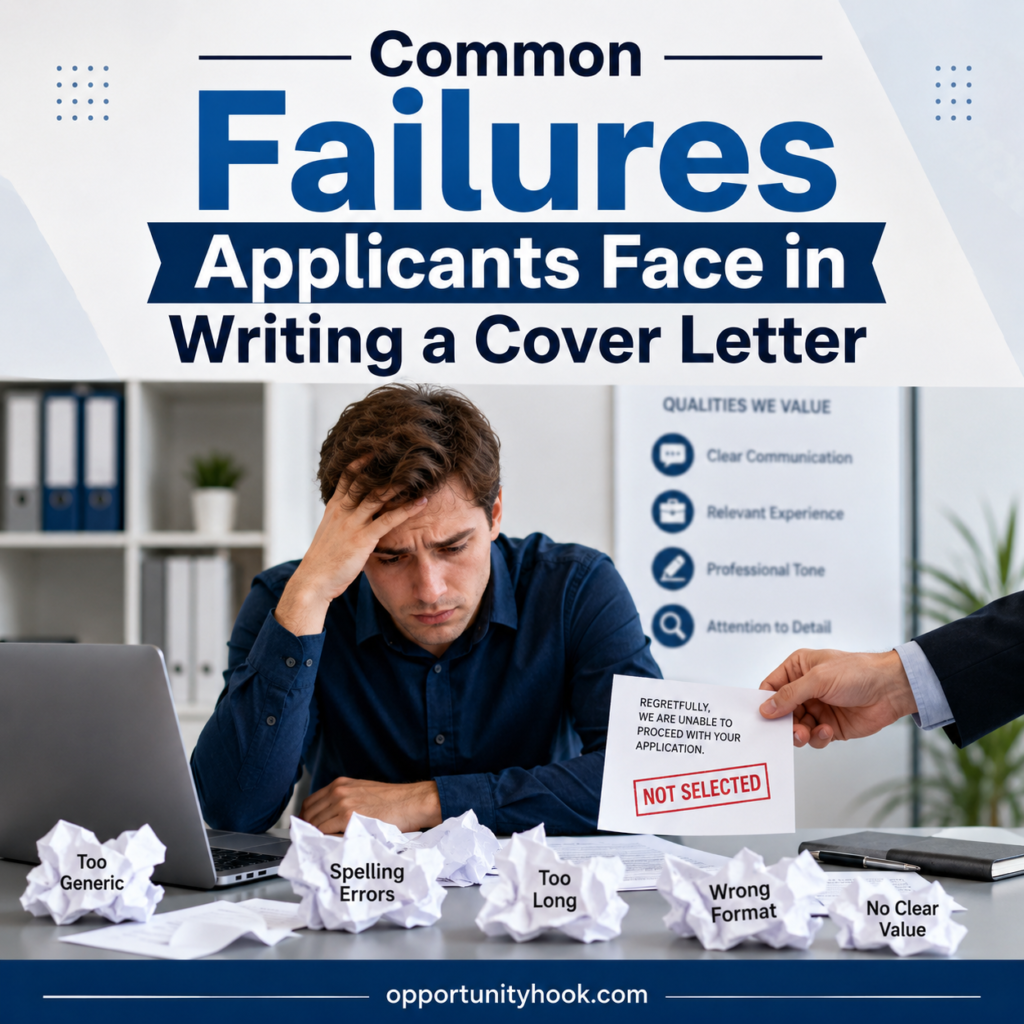
Most people, especially recent graduates, think that writing a good resume is all it takes to get hired for a role. Little do they know that a captivating resume without a complementing cover letter is as good as nothing.
Most newbie applicants spend hours tweaking bullet points, adjusting margins, and ensuring their resume with no experience, looks professional. However, in my years of experience as a career advisor, I have witnessed that poor cover letters are the silent killer of applications.
A cover letter is like the handshake before a conversation, the first impression that matters in your application. Yet, so many qualified candidates are rejected before their resume is even reviewed simply because their cover letter fails to impress.
The confusion is understandable because fresh graduates and newbies are often told to “write a cover letter,” but rarely taught how to do it effectively. The result is often a document riddled with clichés that barely makes it beyond the first glance.
Today, we are going to clear up that confusion. We will break down the common failures applicants face in writing a cover letter, why they lead to rejections, and—most importantly—how to fix them so you can craft a document that opens doors.
Understanding How Hiring Managers Think
Before we begin to analyse the mistakes, you need to understand the context in which your letter is read. A hiring manager or recruiter is busy and is not reading your letter for leisure; they are looking for a reason to move to the next step or throw you in the “no” pile.
So, when your cover letter is poorly written or generic, it forces the reader to figure out why you are competent for the role. If you make them work too hard, they will simply move on to the next. A winning cover letter should connect the dots for them. It should say, “I saw your problem; here is my solution.”
Now, let’s dive into the specific pitfalls that sabotage your chances.
Avoid The “Copy-Paste” Syndrome when Writing a Cover Letter
This is the cardinal sin of cover letters and must be avoided at all costs. It is painfully obvious to recruiters when a candidate has sent the same letter to many companies and merely changed the company name in the header.
Cover letters like this fail because it shows a lack of genuine interest in the vacant role. If you don’t care enough to research the company, why should they care about you? It also fails to address the specific nuances of the job description.
You must tailor every cover letter to uniquely fit each job. If the job description mentions “Project Management,” “Data Analysis,” and “Client Communication” as key requirements, your cover letter should explicitly mention these qualities (naturally) and provide proof of your proficiency.
Example of a Bad Cover Letter Opening:
“I am writing to express my interest in the open position at your company. I believe my skills make me a great fit for this role.”
Example of a Good Cover Letter Opening:
“When I saw the opening for the Digital Marketing Specialist at [Company Name], I was immediately drawn to your recent pivot toward AI-driven campaign analytics. Having increased organic traffic by 40% for a previous employer using predictive modeling, I am confident I can help your team scale its current growth trajectory.”
The second example shows you’ve done homework and you understand the company’s specific challenges.
Don’t Repeat Your Resume In Your Cover Letter
Many applicants treat the cover letter as a narrative version of their resume. They list every job they’ve ever had, every course they took, and every duty they performed. Do not fall for this mistake, which makes the cover letter appear redundant.
If the recruiter wants a list of your past duties, they will look at your resume. Repeating it in paragraph form adds nothing but wastes their time.
The resume is for the “what” and the “where” of your experience, while the cover letter addresses the “why,” the “how,” and the “so what” about those experiences.
So, while writing your cover letter, pick the one or two most impressive achievements from your resume and expand on the narrative. Explain the challenge, your action, and the specific impact you’ve made in that regard.
Instead of saying: “I worked at XYZ Corp for two years doing sales.”
Say: “While at XYZ Corp, I noticed our sales conversion rates were dropping. I spearheaded a new email outreach strategy that moved us away from cold calling. Within six months, we saw a 15% increase in closed deals.”
The second instance shows problem-solving skills, initiative, and results—something a resume bullet simply cannot convey.
Avoid The “Generic Flattery” Trap
Most newbies who are job-hunting begin their cover letter like:
“My name is John, and I am a passionate, hard-working team player. I am applying to your prestigious company because I admire its values and leadership.”
This is the classic filler text of a weak cover letter. It is full of adjectives but empty of evidence. Anyone can claim to be “hard-working.” Saying it doesn’t make it true in the reader’s mind. It reads as insecure and generic.
The solution is to show what makes those qualities true, not just tell about them. If you are a “team player,” describe a time you collaborated with others to hit a target. If you are “passionate,” describe a side project or a specific industry trend that excites you.
So;
Instead of: “I have excellent communication skills.”
Say: “As the liaison between the engineering and sales teams, I translated complex technical jargon into client-friendly benefits, resulting in a 20% reduction in misunderstanding-driven returns.”
Looking at the second example, one could tell that you didn’t just mention what you can do; you showed how and where it has been done.
Don’t Focus Only on What You Want; Offer Value
This is a subtle but critical mistake that continues to reoccur, often seen in cover letters for competitive fields or scholarship recommendation letters. The candidate writes about what the job will do for them and never about what they can offer on the job. For instance:
“This position would allow me to gain experience in the industry…”
“I am looking for a role where I can learn and grow…”
Hiring is a business transaction which must be treated as such. The company is hiring you to solve a problem or make them money. If your letter is all about your personal development, you signal that you are a student, not a contributor, and companies don’t like liabilities.
To preclude rejection, change your sentence structure from “I want to learn” to “I want to contribute.” Focus on the value you bring to them.
Instead of: “This job would give me the opportunity to grow my skills in UX design.”
Say: “I am eager to apply my UX design skills to optimize [Company Name]’s mobile app onboarding flow, reducing user drop-off and increasing retention.”
You are now speaking the language of business impact; what every company needs.
Write a Cover Letter That is Easy to Read Through
Some applicants think writing a longer cover letter equals a more impressive one. They write 1,000 words of dense text spanning a full page that adds no significant value to what the readers want to see.
You must understand that recruiters scan cover letters, and they spend an average of 7 seconds on an initial scan. If they see an enormous letter, their eyes glaze over, and they skip to the resume or move on entirely.
A modern cover letter should be between 250 and 400 words. Use short paragraphs (2-3 sentences max). Use bullet points in the middle body to highlight key achievements if necessary, and make sure you keep the design clean.
The Structure for a Winning Letter:
- The Hook (Paragraph 1): Why you are writing and why you are excited about them (specific).
- The Proof (Paragraphs 2 & 3): 2-3 specific examples of how your skills match their needs. This is where you use the STAR method (Situation, Task, Action, Result).
- The Alignment (Paragraph 4): Why your values align with the company culture.
- The Call to Action (Paragraph 5): Close politely and invite the next step.
Don’t Ignore the “Soft” Requirements
Most job descriptions have a list of “hard skills” and “soft skills” like communication, leadership, and teamwork. Don’t focus only on the hard skills and ignore the soft ones that matter.
Culture fit or soft skill qualities is often the deciding factor between two equally qualified candidates. If you ignore these aspects of the job ad, you appear robotic and will rarely be accepted.
To avoid rejection, explicitly mention the company values in the final paragraph. If the company mentions “innovation,” mention a time you tried a new solution. If they mention “community,” mention your volunteer work.
Mention the soft skills like:
“I was particularly excited to see that [Company Name] values ‘radical transparency.’ In my previous role, I implemented a weekly ‘open dashboard’ meeting that fostered trust and reduced status-update emails by half.”
Close Your Cover Letter With a Call to Action
Many cover letters end with a whimper that often sounds like: “Thank you for your time. I hope to hear from you soon.”
Such a closing fails because it is weak, passive, and doesn’t drive the next step. Your closing should sound polite but confident. And always remember that you are not begging for a job; you are offering a solution.
So;
Instead of: “I hope to hear from you soon.”
Say: “I am eager to discuss how my background in X can drive results for your team. I am available for a call at your convenience next week.”
The Cover Letter Template That Wins Every Time
To tie this all together, here is a template that incorporates the solutions to the mistakes we’ve mentioned above. Do not copy this word-for-word; use it as a structural guide.
Subject: Application for [Job Title] – [Your Name]
Dear [Hiring Manager Name],
Paragraph 1: The Hook
I have been following [Company Name]’s work in [Industry/Project], specifically your recent achievement in [Specific Project/News]. When I saw the opening for the [Job Title] position, I knew I had to apply because my background in [Skill 1] and passion for [Industry] align perfectly with the goals of your team.Paragraph 2: The Proof (Skill 1)
In my previous role as [Previous Job Title] at [Previous Company], I was responsible for [Task]. I noticed a challenge in [Situation]. To solve this, I [Action]. This resulted in [Quantifiable Result—e.g., a 15% increase in sales, a 20% reduction in costs]. I am confident I can apply this same initiative to [Future Company Project/Goal].Paragraph 3: The Proof (Skill 2/Soft Skill)
Beyond my technical skills, I pride myself on my ability to [Soft Skill]. For example, [Short anecdote about when, how, and result of when you applied the skill]. I understand that [Company Name] places a high value on [Company Value], and I believe my collaborative approach would allow me to integrate seamlessly into your culture.Paragraph 4: The Value Proposition
I am excited about the possibility of bringing my expertise in [Skill] to [Company Name]. I am not just looking for a job; I am looking to contribute to a mission that I believe in—specifically, [Company Mission].Paragraph 5: The Call to Action
I would welcome the opportunity to discuss how my background can help [Company Name] achieve its goals for the coming year. Thank you for your time and consideration.Sincerely,
[Your Name]
[Link to Portfolio/LinkedIn]
Cover Letter Templates
The Roadmap to the Corporate Industry
Writing a cover letter is often seen as a chore, but it is actually your greatest opportunity to control the narrative. While a resume is a static document, a cover letter is dynamic. It allows you to answer the “why” before the interviewer even asks the question.
Stop viewing the cover letter as a summary of your history. Start viewing it as a strategic marketing document. Avoid the common failures applicants face in writing a cover letter by being specific, focused on value, and respectful of the reader’s time.
If you fix these pitfalls, you won’t just avoid rejection—you will stand out as the exact candidate the hiring team has been searching for.


