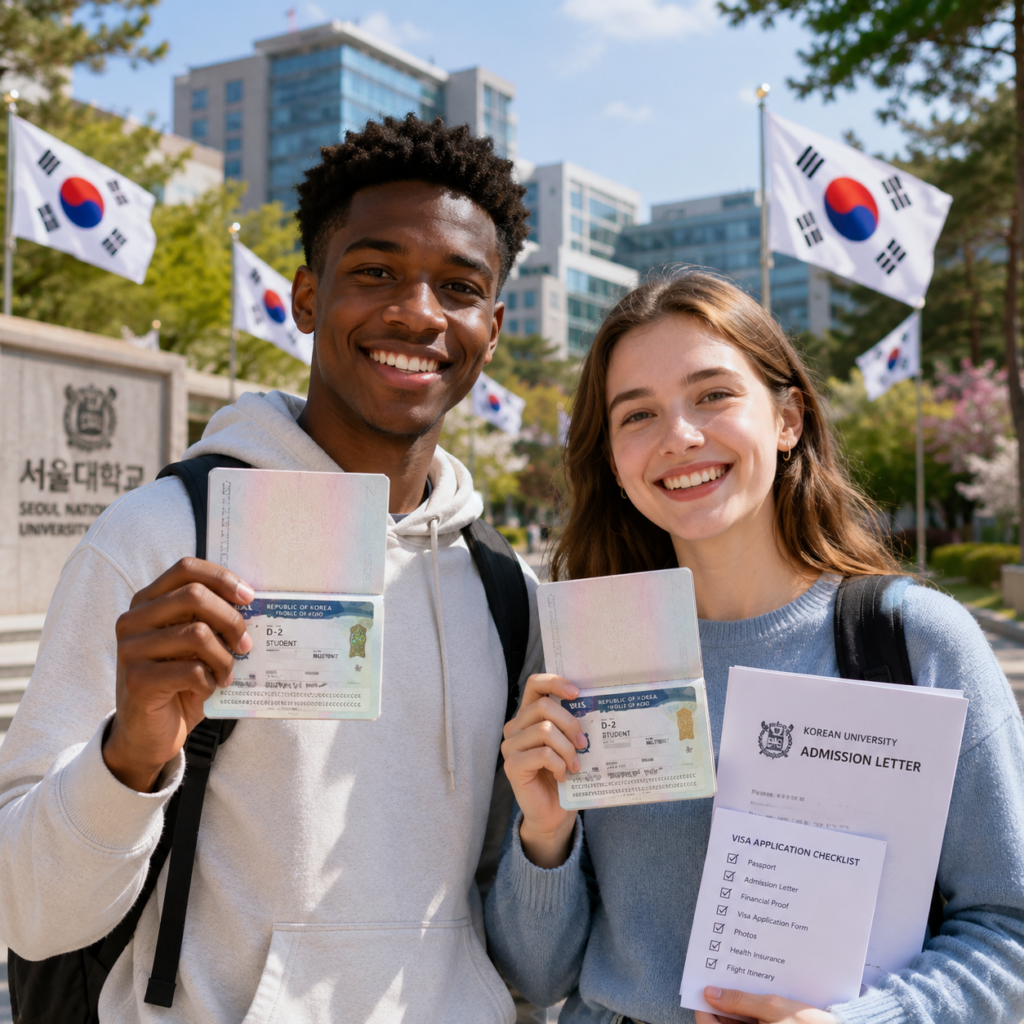
A Korean student visa is an official permit that allows you to enter and stay in South Korea for the purpose of studying. It’s not a tourist visa, and you can’t simply arrive and then enrol. You need this visa before you travel if your course lasts longer than 90 days.
Did you know that South Korea now hosts over 300,000 international students as of early 2026? And the records and trends show that this number is climbing even higher every single year. Students from every corner of the world are choosing Korea as their launchpad, and this choice is well justified. From the cutting-edge AI labs in Daejeon to bustling language schools in Seoul, the country provides a conducive learning environment for international students. And if you’re reading this, you’re probably ready to join them.
If my guess is right, congratulations! You are already on the right track.
But before you can step onto that campus, there’s one hurdle standing between you and your Korean study adventure: getting your Korean student visa. I know—it sounds hectic already, maybe even intimidating. No one likes to go through those stacks of paperwork, strict embassy rules, and confusing financial proof. It’s easy to feel overwhelmed before you’ve even started packing.
To make this journey a lot easier, we’re pulling this article together for you. By the time you finish reading, you’ll understand:
- Exactly which Korean student visa type you need
- Every single document you must prepare
- A step-by-step application process
- The real costs, timelines, and common mistakes to avoid
- What happens after you land in South Korea
By the end, you’ll have a clear, actionable plan and a whole lot more confidence.
Ready to turn that study-abroad daydream into your real life? Let’s get started.
What Is a Korean Student Visa?
A Korean student visa is an official permit that allows you to enter and stay in South Korea for the purpose of studying. It’s not a tourist visa, and you can’t simply arrive and then enrol. You need this visa before you travel if your course lasts longer than 90 days.
The visa is tied to your specific school and program. It proves to the Korean immigration office that you’ve been accepted by a recognised educational institution, you have enough money to support yourself, and you intend to genuinely study and then return home or follow legal stay pathways.
Types of Korean Student Visas
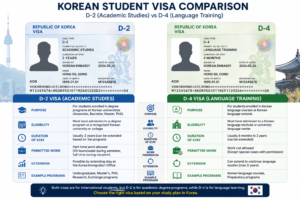
Before you collect any documents for a student visa application, you must know exactly which visa category fits your study plan and how to go about it. The two main student visas for Korean students are the D-2 and the D-4 visas.
1. Korean Student Visa D-2
This is also known as a study visa, and it is the visa for academic degree programs. So, if you’re enrolling in a bachelor’s, master’s, or PhD program at a Korean university, this is your visa. Exchange students who come through a formal university agreement also often fall under the D-2 category.
2. D-4 Korean Visa
The D-4 visa is a general training visa for non-degree training. The most common type is the D-4-1 visa, which is for Korean language programs at university-affiliated language institutes. If your goal is to learn Korean first before entering a degree program, you’ll likely start with a D-4 visa and later change to a D-2 visa from within Korea.
Let’s compare visa types side-by-side so the differences become crystal clear.
| Visa Type | Purpose | Typical Duration | Part-Time Work Allowed? |
|---|---|---|---|
| D-2 (Korean student visa) | For Degree programs, such as Associate, Bachelor’s, Master’s, PhD, and official exchange studies | Length of your degree program | Yes, after receiving immigration permission, which is usually available after 6 months |
| D-4 (Language Training visa) | Korean language study at a university-affiliated language institute, plus cultural or technical training | 6 months to 2 years | Limited — only after 6 months and with tighter hourly restrictions |
If your main plan is to get a degree, you will have to focus on the Korean student visa D-2. But if you first want to study the Korean language, you will apply for a D-4 visa, then later apply for a D-2 change of status. Both paths are common and completely valid.
Korean Student Visa Requirements
Let’s talk about what Korean embassies expect from you when you want to apply for a student Visa. The exact Korean student visa requirements can differ slightly depending on your home country and the specific Korean embassy or consulate you apply through. However, the core checklist is very stable worldwide.
Here’s the general list in a simple, plain explanation:
- You must provide your certificate of acceptance, the official letter from your Korean university proving you’ve been accepted. It is the most important document in your application. Without it, no student visa application can start.
- Your passport must have at least 6 months of validity remaining and at least 2 blank visa pages.
- Provide a passport-sized photo, usually two recent colour photos with a white background. Check the exact size requirement (often 35mm x 45mm).
- You will fill out the official visa application form known as Form No. 34. This asks about your personal details, education, and intended stay.
- You will provide proof of funds, such as bank statements or sponsorship letters showing you have enough money to cover tuition and living costs. We’ll discuss exact amounts later.
- Provide your highest degree diploma and transcripts. For D-2 degree programs, you’ll need your high school diploma (for bachelor’s) or bachelor’s degree (for master’s). Language schools may only need high school completion.
- Some embassies require a basic health check, tuberculosis (TB) test, or a certificate stating you are free from certain communicable diseases. Always check your local embassy’s latest advice.
- Many universities ask you to pay at least one semester’s tuition before they issue the Certificate of Admission. The receipt may be required as part of your visa documents by the embassy.
- Travel Insurance is not always mandatory for the visa itself, but strongly recommended and sometimes requested to prove you can handle medical emergencies.
Does this list look long? Don’t worry – the next section breaks it down into a detailed, organised table so you can check off items one by one. But before we proceed, you might love to review our guide on Fast-Track to Get a Canadian Study Permit in 2026
Documents Required for a Korean Student Visa
Preparing the right documents required for a Korean student visa application is often the most stressful part, simply because students fear missing something. I’ve created a detailed checklist table for you. Use it like a recipe – gather everything before your embassy appointment.
| Document Name | Purpose | Original or Copy? | Translation Needs |
|---|---|---|---|
| Certificate of Admission | Proves university acceptance | Original required | Usually already in English or Korean; no extra translation |
| Completed Visa Application Form | Official request for a visa | Original, signed | The embassy provides a form in English and the local language |
| Passport | Identity and travel document | Original plus a copy of the bio page | N/A |
| Passport Photos | Identification on a visa | Original physical photos | N/A |
| Bank Statements | Shows you can afford living and tuition | Original or certified copy | An English translation may be needed if the bank issues in another language |
| Scholarship Letter (if applicable) | Reduces or replaces the bank statement requirement | Original letter from the university | Usually in English |
| Highest Education Diploma and Transcripts | Proves academic background | Original + copy | Notarised translation into English or Korean is often required |
| Tuition Payment Receipt | Shows commitment and financial transaction | Copy usually acceptable | Notarised translation if not in English or Korean |
| Medical Certificate | Health screening requirement | Original medical report | The embassy may specify approved clinics |
| Sponsorship Letter and Sponsor’s ID | If someone else funds your studies | Original signed letter + sponsor’s bank proof | Translation of sponsor documents if not in English or Korean |
| Employment Proof or Leave Letter (if employed) | Shows ties to the home country | Copy | Translation if needed |
It is important to note that almost all documents not in English or Korean must be translated. The embassy usually requires a notarised translation. Do not submit plain personal translations. Ask your local Korean embassy if they have a list of accepted translation services. This small step alone can prevent a visa rejection.
Now that you know what to prepare, let’s move to the actual application journey – the step-by-step path of how to get a Korean student visa.
How to Get a Korean Student Visa With Ease
This is the heart of the guide. Follow these steps in order, and you’ll dramatically reduce the stress attached to securing a Korean student visa.
Step 1: Apply and Get Admitted to a Korean University
Your entire visa journey starts with a university acceptance. You cannot apply for a Korean student visa without an admission letter. So, research programs, check application deadlines, and submit your documents. Once accepted, the university will send you the official Certificate of Admission. This is your golden ticket.
Step 2: Receive Your Certificate of Admission
The university usually sends this via email or courier. Check all personal details and make sure your name matches your passport exactly. If there’s a typo, contact the university immediately. Do not proceed with a mistake on this certificate.
Step 3: Prepare All Your Korean Student Visa Documents
Using the checklist table above, collect every single paper needed. I recommend putting them in a clear plastic folder in the exact order the embassy lists them. Make extra copies of everything. This shows you are organised and serious.
Step 4: Book Your Embassy or Consulate Appointment
Visit the official website of the Korean embassy or consulate in your home country. Find the visa section and schedule an appointment. Some embassies accept walk-ins only for student visas, but many now require prior booking. Do this weeks ahead because slots fill up quickly before the semester starts.
Step 5: Pay the Korean Student Visa Fee
You will pay the application fee when you submit your documents. We’ll look at the exact costs in the next section. Keep the receipt.
Step 6: Attend the Interview (If Required)
Not every applicant is interviewed, but many are. The consular officer wants to confirm you’re a genuine student. Answer clearly and honestly. I’ll share common interview questions later.
Step 7: Wait for Processing
After submission, your passport and documents stay with the embassy. The processing time varies, but you will get your passport back with the visa sticker affixed inside.
Step 8: Receive Visa and Prepare for Travel
Once you get that visa, celebrate! Then immediately check the visa sticker for any errors. Book your flight and start packing. Remember, you must enter Korea within the visa’s validity window.
Korean Student Visa Fee
How much does a Korean student visa cost? There is no single global answer because visa fees vary by country, visa type, and reciprocity agreements. However, I can give you a realistic range and extra costs you should budget for.
Typical visa application fee range:
- Single-entry visa (90 days or less initial stay): approximately US $30 to $50 for many countries, but can be up to US $70 to $90 in others.
- Multiple-entry visa: higher, around USD $80 to $120. D-2 students often get a single-entry first and then a multiple-entry permit after obtaining the Alien Registration Card in Korea.
Always check your local Korean embassy’s website for the exact fee to pay. The fee is non-refundable, even if your visa is denied.
Additional expenses to plan for:
- Document notarization and translation fees: can range from US $20 to $50 per page, depending on your country.
- Courier fees if you’re mailing your application or receiving your passport back.
- Medical check fee: if a TB test or health certificate is required, budget around US $30 to $100.
- Travel insurance: a basic student plan might cost US $100 to $300 annually.
These small costs add up. So when you think about the Korean student visa fee, remember it’s the application fee plus these side expenses. A total budget of US $150 to $300 for the whole documentation process is a smart estimate.
Korean Student Visa Processing Time
How long does it take to process a Korean student visa? Generally, the processing time is between 5 and 14 business days after submission. However, this varies.
Typical timelines:
- Some embassies process D-4 language visas within 3–5 working days.
- While the D-2 degree visas often take 7–14 working days.
If your documents need verification with the university or immigration in Korea, it can stretch to 3–4 weeks.
Factors that can cause delays:
- Peak application seasons when thousands of students apply at the same time.
- Incomplete documents require you to resubmit.
- Additional background checks.
When should you apply? As soon as you receive your Certificate of Admission and have all other documents ready. Ideally, submit your application at least 4–6 weeks before your flight. That gives you a comfortable buffer.
Korean Student Visa Interview Questions
If you’re called for an interview, don’t panic. The officer simply wants to verify your story and genuineness. The questions will feel like a friendly but focused conversation. Here are the most common ones and how to approach them.
Sample interview questions:
- Why do you want to study in South Korea and not in your home country?
Tip: Mention specific academic reasons, a professor’s research, the university’s global ranking, or the unique curriculum. Avoid saying “I love K-pop” as the main reason. - Which university and program did you get admitted to?
Tip: Know the full university name, your major, and even the campus location. Showing you did your homework builds trust. - How do you plan to fund your studies?
Tip: Confidently explain your funding source: parents, scholarship, or savings. Have the documents mentally ready. - Do you plan to work part-time while studying?
Tip: It’s okay to say you may apply for a legal part-time work permit after arrival, but make it clear your main purpose is studying. - What will you do after graduation?
Tip: Emphasise returning to your home country or pursuing further study legally. Never say you want to stay and work illegally.
Answering confidently:
- Speak clearly, maintain eye contact, and be honest.
- If you don’t understand a question, politely ask for clarification.
Dress neatly; first impressions matter, even at a visa counter.
Common Reasons for Visa Rejection
No one wants a rejection, but knowing why they happen helps you steer clear. Common reasons include:
- Submitting incomplete or incorrect documents is one of the major causes of rejection. Missing bank statements, untranslated certificates, or forms with errors.
- If the balance on your proof of finance is too low or the funds are not properly explained.
- Watch out for inconsistent information. Visas are often rejected when your interview answers don’t match your application form.
- Submitting false bank statements or diplomas gets you automatic rejection. This is taken extremely seriously and can lead to a permanent ban.
- Poor interview performance is another cause of visa rejection when you’re unable to explain why you chose Korea or your program.
- If the officer suspects you mainly intend to work, not study, your visa can easily be rejected based on an unclear study purpose.
If your Korean student visa is rejected, don’t lose hope. You can often reapply after fixing the issues. Ask the embassy for the reason, correct the problem, and try again with stronger documentation.
Frequently Asked Questions
How much bank balance is required for a Korean student visa?
For a D-2 visa, you generally need to show around USD 10,000–20,000 in funds plus tuition payment proof. D-4 visa applicants often show USD 5,000–7,000. Confirm with your specific Korean embassy, as amounts vary.
Is IELTS required for a Korean student visa?
The visa itself doesn’t require IELTS or TOEFL. However, your university admission likely does. If your program is in English, you’ll need English proficiency scores for admission, not for the visa. Some embassies may ask for language scores to verify study readiness, but it’s not a universal visa requirement.
How long does a Korean student visa take?
Usually 5–14 business days after submission. During peak periods, it might extend to 3–4 weeks. Always plan for a month of processing time.
Can I work while studying in Korea?
Yes, but with restrictions. D-2 visa holders can apply for part-time work permission 6 months after arrival. Undergrads can work up to 20 hours/week during the semester, unlimited during holidays. D-4 holders can work only after 6 months with tighter limits. Never work without immigration permission.
What is the Korean student visa D-2?
It’s the study visa for degree-seeking international students. If you’re doing a bachelor’s, master’s, or PhD program, you’ll be on a D-2 visa. There are sub-types like D-2-1 for associate degree, D-2-2 for bachelor’s, D-2-3 for master’s, D-2-4 for PhD, and D-2-6 for exchange students.
Can a Korean student visa be rejected?
Yes. Rejection often happens due to missing documents, insufficient funds, inconsistent information, or doubt about your genuine study intent. The good news is that you can reapply after fixing the issues.
Studying in Korea is Easier Than it Seems
Getting your Korean student visa is a process, yes. But it’s a manageable one. You’ve now walked through every stage – from understanding the visa types and requirements to nailing the interview and settling in after arrival. That nervous feeling you started with? I hope it’s been replaced by clarity and a solid action plan.
Remember the key points: start early, gather your Korean student visa documents meticulously, be honest about your finances, and treat the embassy process with respect and preparation. Thousands of students from around the world are starting their Korean adventure this very year. You’re about to join them.
Your dream of studying in South Korea is closer than you think. Take that first official step today – check your university application deadline, start organising your paperwork, and move forward with confidence. You’ve got this.
External Authority Sources
Mention or reference these trusted sites to boost EEAT signals:
- Korea Immigration Service (Hi Korea) – hikorea.go.kr (official visa and ARC information)
- Study in Korea (NIIED) – studyinkorea.go.kr (government scholarship and university search)
- Korean Embassy or Consulate Directory – overseas.mofa.go.kr (localised visa announcements)
- Ministry of Education, Republic of Korea – English.moe.go.kr (policy updates)
- National Health Insurance Service (NHIS) – nhis.or.kr (health insurance for international students)