
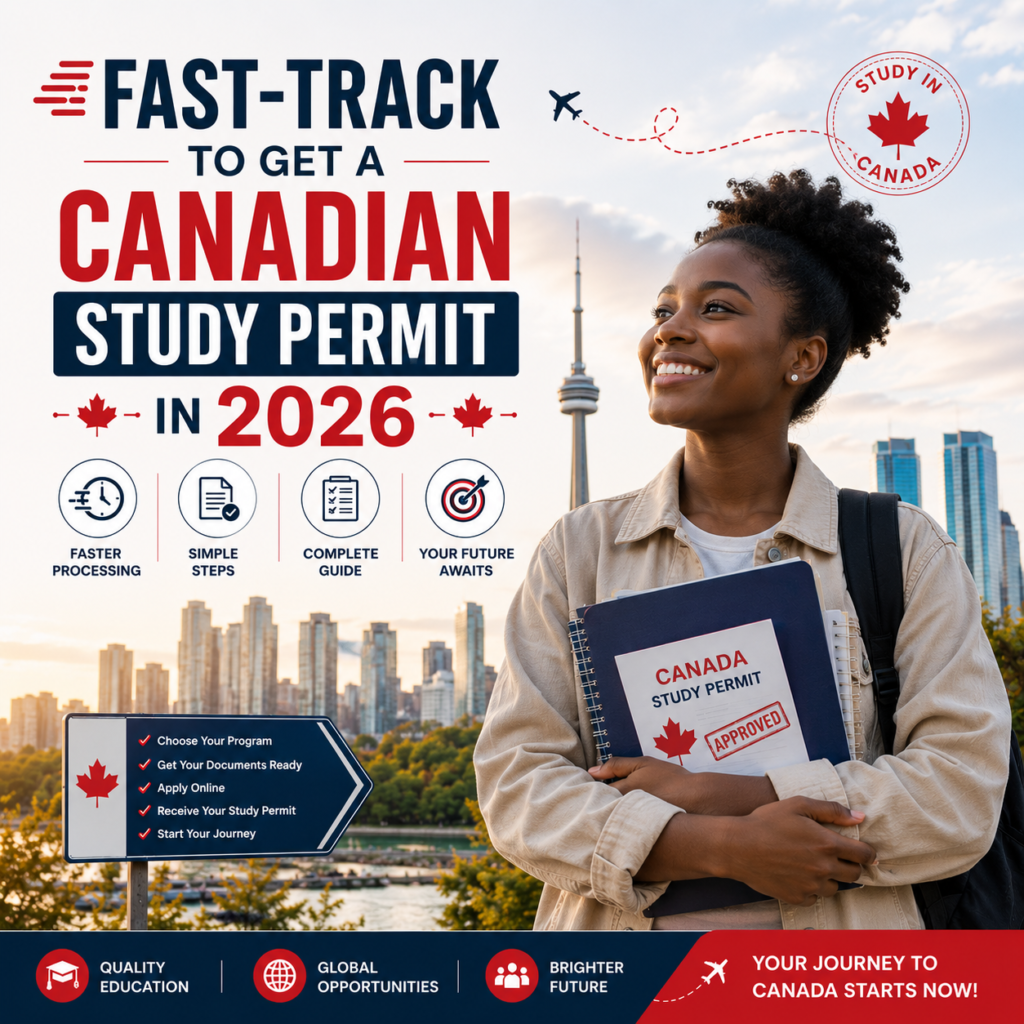
A Canada study permit is an official document issued by Immigration, Refugees and Citizenship Canada (IRCC) that allows foreign students to study in Canadian learning institutions. Before we dive in deeper, it is important to understand that a study permit is not a visa. It does not, by itself, grant you entry into Canada rather a permission to study. You may also need either a Temporary Resident Visa (TRV) or an electronic Travel Authorization (eTA) to enter the country .
Think of it this way: your study permit gives you permission to stay and study once you are inside Canada, while your visa or eTA is what gets you through the door at the border.
The process of obtaining a Canadian study permit has changed significantly for 2026. Whether you are a prospective graduate student or an undergraduate applicant, understanding these new rules is the first step toward a successful application, so let us quickly get into it. In this guide, we will walk you through everything you must know about the Canada study permit application process, with special focus on fast-track options for eligible applicants.
What are the Changes to Canada’s Study Permit System in 2026?
Canada has introduced transformative changes in how to obtain a study permit for 2026. These updates create a two-tier system that significantly favours certain categories of applicants while maintaining structured pathways for others.
The New Two-Tier System
Tier 1: Graduate Students
If you are applying for a master’s or doctoral program at a public Canadian institution, you are in the most advantageous position. Starting January 1, 2026, graduate students enjoy these three major benefits :
- No Provincial Attestation Letter Required: Yes, you can skip this step, which causes major delays for other applicants.
- Exempt from National Cap: The 408,000 permit limit does not apply to graduate students. Whether 10,000 or 100,000 apply, all will be processed.
- Fast Processing: PhD students and their families can receive approval in just 14 days when applying with complete documentation.
Tier 2: Undergraduate and College Students
If you are applying for undergraduate programs, college certificates, or studying at private institutions, you face a different landscape:
- You must obtain a Provincial Attestation Letter (PAL) before applying
- You compete for spots within the 155,000 new student permits
- Provincial quotas fill on a first-come, first-served basis
- Early application is absolutely critical for success
What is the Number of Study Permits Canada Accepts?
For 2026, Canada has capped total study permits at 408,000. Here is how they break down:
| Category | Number of Permits | Percentage |
|---|---|---|
| New international students | 155,000 | 38% |
| Current students extending permits | 253,000 | 62% |
If you are already in Canada on a valid status, you compete in the larger 253,000 pool, which gives you significantly better odds than applicants in their home countries.
How to Apply for a Fast Canada Study Permit in Steps
Now that you understand the landscape, let us explain the actual application process. Whether you are applying through the Canada study permit application portal or seeking to apply for a Canada study visa online, these steps apply to everyone.
Step 1: Secure Your Letter of Acceptance
Your journey begins with acceptance from a Designated Learning Institution (DLI). You might be wondering what a DLI is and how it affects your application. A DLI refers to any school approved by the Canadian government to host international students. Enrolling at a non-DLI institution, even accidentally, can result in immediate deportation and a 10-year entry ban.
Apply to multiple schools in different Canadian provinces. This strategy gives you more options for obtaining Provincial Attestation Letters and significantly increases your chances of acceptance.
Step 2: Determine Your Provincial Attestation Letter (PAL) Status
The Provincial Attestation Letter, otherwise known as PAL, has become the most critical document for most applicants. Think of it as your golden ticket—without it, IRCC will return your application with fees, no questions asked.
Who Needs a PAL?
- Undergraduate students
- College certificate and diploma students
- Graduate certificate and postgraduate diploma students
- Visiting students staying more than six months
Who doesn’t need a PAL?
- Master’s and PhD students at public institutions (effective from January 1, 2026)
- Children in grades K-12
- Current study permit holders extending to the same institution
- Exchange students under formal arrangements do not pay tuition to the Canadian institution
- Global Affairs Canada scholarship recipients
If you are PAL-exempt, you must include proof of your exemption in your application. This typically means writing a letter explaining why you qualify and attaching supporting documents.
Step 3: Gather Your Required Documents
Once you know your PAL status, it is time to assemble your application package. All applications must be submitted online through the IRCC secure account (GC Key)—the IRCC Portal no longer accepts study permit applications.
Here are the universal requirements you will need :
| Document | Details |
|---|---|
| Valid passport | Must be valid for at least 6 months beyond your expected arrival date |
| Letter of Acceptance | Official LOA from your DLI showing your name, student number, program dates, and DLI number |
| Provincial Attestation Letter | If required (or proof of exemption) |
| Proof of financial support | Bank statements, GIC, scholarship letters, or loan documents |
| Digital passport photo | Taken within the last 6 months, following IRCC specifications |
| Application form (IMM1294) | Download from your online checklist, use the most current version |
| Letter of explanation | Your study plan and proof of ties to your home country |
| Biometrics fee ($85 CAD) | Unless you have valid biometrics on file from the last 10 years |
Step 4: Prepare Your Financial Proof
One of the most common reasons for application rejection is insufficient financial documentation. For applications submitted on or after September 1, 2025, you must demonstrate access to at least $22,895 CAD for living expenses (for 12 months) plus your first year’s tuition costs.
Acceptable Proof of Funds Includes:
- Bank statements from the past 4-6 months in your name
- Guaranteed Investment Certificate (GIC) from a participating Canadian financial institution
- Proof of student or education loan from a bank
- Letter from the person or institution providing funding
- Bank draft convertible to Canadian dollars
- Proof of paid tuition and housing fees
If funds come from family members, include a signed letter confirming their willingness to support you, proof of your relationship, and their bank/income statements.
Step 5: Write Your Letter of Explanation and Study Plan
This document is your opportunity to tell your story to the immigration officer. A strong letter should address:
- Why you chose Canada and your specific program
- How this program fits with your academic and professional history
- Your long-term career goals and how this degree supports them
- Why you are not pursuing similar studies in your home country
- Your ties to your home country (family, property, job prospects) that ensure you will return after your studies
Keep this letter to one page and be honest, specific, and genuine.
Step 6: Complete Biometrics and Medical Examination
Biometrics: Most applicants between 14 and 79 years old must provide fingerprints and a photo at a designated collection point. You pay the $85 fee when submitting your application, and you receive a Biometrics Instruction Letter (BIL) afterwards. Schedule your appointment promptly—biometrics are valid for 10 years.
Medical Examination: You need an Immigration Medical Exam (IME) if you have lived in a designated country for six or more consecutive months in the year before applying. Start this process early, as results can take months to process.
Step 7: Submit Your Application and Track Processing
Submit your complete application through your IRCC secure account. Processing times vary by country, but here is what you can expect :
- PhD students: 14 days (with complete application and simultaneous family applications)
- Standard processing from India: Approximately 3 weeks
- Other countries: Check current estimates on the IRCC website
Critical Warning: Your processing clock does not start until IRCC receives every required document in an acceptable format. Missing items can add weeks or months to your timeline.
How Much in a Bank Statement Is Needed for a Canada Study Visa?
We often get this question from applicants who are confused about the sufficient amount statement for a study visa, so let us address it directly.
The answer depends on your tuition costs and family situation. Here is how to calculate what you need to show :
Minimum Financial Requirement Formula:
Example Calculation:
For a master’s program with $35,000 CAD annual tuition:
- Tuition: $35,000
- Living expenses: $22,895
- Total to demonstrate: $57,895 CAD
If you are bringing family members, add :
- Spouse/common-law partner: Additional $4,000 CAD
- Each dependent child: Additional $3,000 CAD
What Do Immigration Officers Look For in Bank Statements?
- 4-6 months of history: Statements should show consistent balances, not sudden large deposits
- Clear source of funds: Large deposits must be explained (e.g., “sale of family property” with supporting documents)
- Accessibility: Funds must be readily available, not tied up in assets that cannot be quickly liquidated
Pro Tip: If using family funding, include their bank statements, a signed support letter, and proof of relationship. This combination creates a compelling financial picture.
What Are the New Rules for International Students in Canada 2026?
Let us summarise the most important rule changes for 2026 that affect your application and your time in Canada.
1. Graduate Student PAL Exemption
As discussed, master’s and doctoral students at public institutions no longer need Provincial Attestation Letters starting January 1, 2026. This change eliminates the biggest bottleneck in graduate applications.
2. PhD Fast-Track Processing
Doctoral students now qualify for 14-day processing—the fastest immigration processing in Canadian history. This benefit extends to spouses and dependent children, but only if they apply simultaneously as part of your package.
3. Increased Financial Requirements
The cost-of-living threshold increased to $22,895 for applications after September 1, 2025—a 34% increase that has caught many applicants unprepared.
4. 24-Hour Work Limit Enforcement
International students can work up to 24 hours per week off-campus during academic sessions. Immigration officers now enforce this limit with zero tolerance. Exceeding 24 hours, even by one hour, can result in :
- Loss of student status
- Visa cancellation and deportation
- Permanent ineligibility for Post-Graduation Work Permit (PGWP)
What Counts Toward the 24 Hours:
- Off-campus employment
- Freelance work
- Online tutoring or consulting
- Gig economy work (Uber, delivery driving)
What Does NOT Count:
- On-campus work at your institution
- Work during scheduled breaks
- Co-op or internship placements that are part of your curriculum
5. Post-Graduation Work Permit (PGWP) Updates
The PGWP remains your bridge from student to permanent resident. Key updates for 2026 include :
- Language requirement: Most applicants must submit language test results (IELTS, CELPIP, or PTE)
- Field of study matters: Programs in agriculture, healthcare, STEM, trades, and French instruction receive priority
- Duration:
- Programs under 2 years: Permit matches program length
- Programs 2+ years: 3-year permit
- Master’s programs (starting after Feb 15, 2024): 3-year permit regardless of program duration
6. In-Canada Application Advantage
If you are already in Canada on a valid status, you have a significant advantage. Of the 408,000 total permits, 253,000 (62%) are reserved for current residents and extensions. This means you face less competition and have better approval odds than applicants from abroad.
Common Mistakes That Delay Study Permit Applications
With increased competition, small errors have bigger consequences. Avoid these pitfalls:
1. Applying Without a Required PAL
Undergraduate students who apply without a Provincial Attestation Letter receive automatic application returns with fee forfeiture. This mistake costs 4-6 weeks in restart time.
2. Incomplete Financial Documentation
Vague or insufficient financial proof is a leading cause of refusals. Show clear, documented sources with 4-6 months of history.
3. Generic Statements of Purpose
Immigration officers read thousands of applications. A generic letter that does not address your specific situation or ties to your home country raises red flags. Be authentic and detailed.
4. Waiting Too Long to Apply
Undergraduate spots fill on a first-come basis. Waiting until summer for a fall start means many provincial quotas are already exhausted.
5. Leaving Canada During Application Processing
If you are in Canada and apply for a study permit, leaving the country while your application is being processed terminates your ability to study upon return. You cannot begin studies until your permit is approved and you re-enter.
6. Misunderstanding Exemption Status
Graduate students who assume PAL exemption without properly documenting it face application returns. Include a clear explanation letter with your application.
When to Apply for a Canada Study Permit 2026?
Your application timing can make or break your Canadian dreams. Here is your strategic timeline:
For Graduate Students (PAL-Exempt)
Apply immediately upon receiving your Letter of Acceptance. Since most doctoral program deadlines fall between December and January, successful applicants typically receive acceptances by February or March—plenty of time for September start dates.
For Undergraduate Students (PAL-Required)
You need a two-step timeline:
| Step | Timing | Action |
|---|---|---|
| 1 | Immediately after acceptance | Apply for Provincial Attestation Letter |
| 2 | Upon receiving PAL | Submit a study permit application |
| Best window | January-March | Highest success rates, full quotas |
| Moderate | April-June | Some competition as quotas fill |
| High risk | July-September | Intense competition, limited spots |
| Extreme risk | October-December | Very limited remaining spots |
Processing Time Reality Check
Processing times vary by country, but here are general estimates :
- PhD applicants: 14 days (with simultaneous family applications)
- India standard processing: Approximately 3 weeks
- Other countries: Check the IRCC website for current estimates
- Add buffer: Include 2-4 weeks beyond official estimates for safety
Can I Work in Canada After My Graduation?
Your study permit is the first step in a larger immigration journey. Understanding the full picture helps you make better decisions now.
The Post-Graduation Work Permit (PGWP)
After completing your studies at a participating DLI, you may qualify for a PGWP that allows you to work in Canada. This work experience directly supports permanent residence applications.
PGWP Eligibility Requirements :
- Graduated from a DLI program of at least 8 months
- Maintained full-time student status throughout (except final semester)
- Meet language proficiency requirements
- Apply within 180 days of receiving confirmation of program completion
Pathways to Permanent Residence
Successful students can transition to permanent residence through :
- Canadian Experience Class (CEC)
- Provincial Nominee Programs (PNPs)
- Express Entry draws with Canadian education points
FAQ About Canada Study Permit
Do I need a Provincial Attestation Letter for my master’s program in 2026?
No. Starting January 1, 2026, master’s and PhD students at public institutions are completely exempt from PAL requirements. You can apply immediately after receiving your Letter of Acceptance without waiting for provincial approval. However, you must properly document your exemption status with a clear explanation letter in your application.
How much is needed on a bank statement for a Canadian study visa?
You must demonstrate access to funds covering first-year tuition plus $22,895 CAD for living expenses. For a typical master’s program with $35,000 tuition, this totals approximately $57,895 CAD. If bringing family, add $4,000 for spouse and $3,000 per child. Bank statements should show 4-6 months of history with clear fund sources.
How fast is the PhD study permit processing in 2026?
PhD students qualify for 14-day processing when applying online from outside Canada with complete documentation. This fast-track extends to spouses and dependent children, but only if they apply simultaneously as part of your package. Family members applying separately revert to standard processing.
Can I work more than 24 hours per week during breaks?
Yes. The 24-hour weekly limit applies only during regular academic sessions. During scheduled breaks between semesters, you can work full-time. However, working even one hour over the limit during academic sessions can result in loss of status and permanent PGWP ineligibility.
What happens if my study permit application is refused?
If your application is refused, you will receive a letter explaining the reasons. You can address the issues and reapply. If your refusal occurred after obtaining a PAL, you will need a new PAL for your reapplication, as the original becomes invalid. Contact your university’s international student office for support.
Can I apply for a study permit while visiting Canada?
Yes, visitors in Canada can apply for study permits, but this requires careful navigation. You maintain legal status during processing, but cannot leave Canada until approved. Immigration practitioners strongly recommend professional consultation for visitor applications, as requirements are complex.
Do I need a separate visa to enter Canada?
Yes. Your study permit allows you to stay in Canada, but you also need entry authorisation. Depending on your nationality, this is either a Temporary Resident Visa (TRV) placed in your passport or an electronic Travel Authorisation (eTA) linked to your passport. Successful study permit applications automatically include appropriate entry authorisation.
Your Action Plan for 2026 Success
The Canadian study permit process for 2026 rewards strategic thinking and early action. Here is your step-by-step plan:
If You Are a Graduate Student:
- Research programs and identify your target universities
- Prepare application materials well before deadlines
- Apply for admission to multiple programs
- Upon acceptance, immediately prepare your study permit application
- For PhD applicants, coordinate family member applications simultaneously
- Submit a complete application with proof of PAL exemption
- Track processing and prepare for arrival
If You Are an Undergraduate Student:
- Apply early to multiple institutions in different provinces
- Research provincial PAL processes for your target locations
- Upon acceptance, immediately apply for PAL (do not wait!)
- Prepare financial documents showing 4-6 months of history
- Submit the study permit application immediately upon receiving PAL
- Apply in January-March for the highest success rates
- Have backup plans in different provinces
For All Applicants:
- Start financial documentation early—build your bank statement history now
- Prepare your study plan thoughtfully—this is your story, make it count
- Check processing times for your country and add a buffer
- Review all documents multiple times before submitting
- Apply online only—paper applications are rarely accepted
The Right Time Is Now: Take Action
The 2026 changes to Canada’s study permit system create unprecedented opportunities for graduate students while maintaining structured pathways for undergraduate applicants. Success depends on understanding your category’s specific requirements and timing your application accordingly.
Remember, your study permit is more than permission to attend school—it is your entry ticket to a world-class education and potentially a new life in one of the world’s most welcoming countries. The application window is open, provincial quotas are filling, and your competition is already preparing their documents.
At Opportunity Hook, we believe that accurate information and strategic planning can turn your Canadian dreams into reality. Use this guide as your roadmap, start your preparation today, and take that first step toward your future.
Do you have specific questions about your situation? Leave a comment below, and our community will try to help! Subscribe to our newsletter for more updates on study permits, scholarships, and immigration pathways.


This Post Has 2 Comments