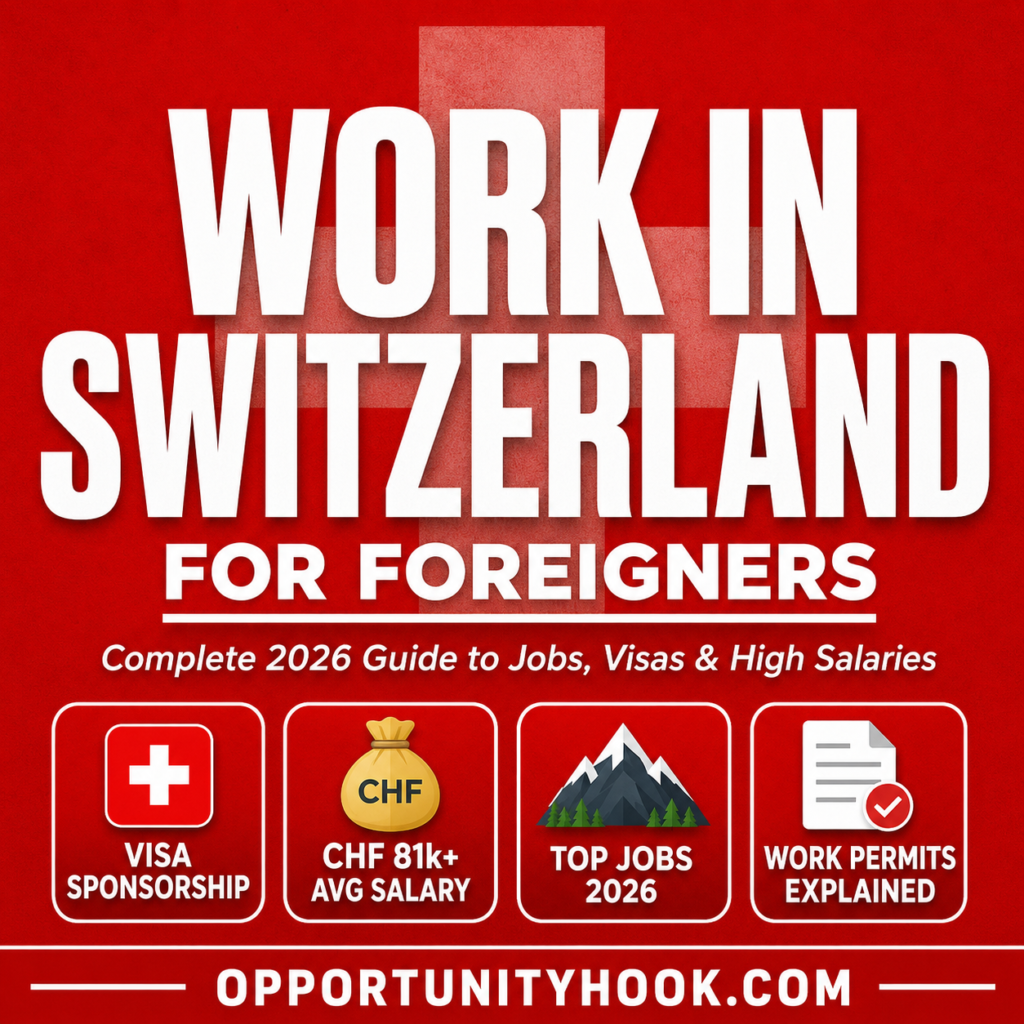
This complete guide breaks down exactly how to land a job, secure visa sponsorship, and earn top CHF salaries, whether you’re a tech expert or seeking unskilled work.
Working in Switzerland as a foreigner could be the best career decision you ever made. The country consistently ranks as one of the most attractive destinations for international professionals. With its booming economy and some of the highest salaries in the world, it’s not surprising that thousands of foreigners are moving here for work each year
For context, in 2026, Switzerland was named the best country in the world for jobs, pay, and career growth by the Henley Opportunity Index, with an impressive score of 86 out of 100. Approximately 27% of Switzerland’s workforce now consists of foreign nationals.
Meanwhile, working in Switzerland as a foreigner is not as simple as it seems. The country operates a strict, quota-based immigration system that heavily favours EU citizens. For non-EU nationals, the path is competitive, employer-driven, and subject to annual caps.
However, this guide is designed to walk you through everything you need to know before you apply—from visa options and work permits to the best jobs in Switzerland for foreigners, salary expectations, and practical steps to land your dream Swiss job. Whether you’re a highly skilled professional or looking for unskilled jobs in Switzerland for foreigners, this resource has you covered.
What Makes Switzerland a Good Choice for Foreign Workers?
International workers are not choosing Switzerland just for aesthetics; numerous reasons reveal why the country has become a popular destination for professionals. To point out a few, the qualities include:
1. A Powerhouse Economy with Low Unemployment
Switzerland has one of the strongest and most resilient economies in Europe. In 2026, data show that the unemployment rate remains historically low at around 2.2%, creating a market environment in which companies actively compete to attract talented international workers. In January 2026, the unemployment rate increased to 3.2%, with over 48,900 vacancies reported.
2. Unmatched Salaries
Another important aspect of Swiss work is the attractive pay. The average salary in Switzerland is approximately CHF 81,600, which is about US$105,240 per year, with an average monthly salary of around CHF 6,700–6,800. Some sectors such as finance, pharmaceuticals, and technology pay significantly higher, with some senior roles paying more than CHF 150,000 annually.
3. Exceptional Quality of Life
Switzerland consistently ranks among the top countries globally for quality of life. The country offers:
- World-class healthcare with universal coverage
- Excellent public education and international schools
- Low crime rates and high personal safety
- Efficient public transport connecting every corner of the country
- Work-life balance with a 42-hour average workweek and generous holiday entitlements
4. Career Growth and Professional Development
Switzerland is a global hub for banking, pharmaceuticals, technology and many more. Working here gives you exposure to cutting-edge industries, multinational companies, plus a network of highly skilled professionals from around the world.
Can Foreigners Legally Work in Switzerland?
Yes, foreigners can legally work in Switzerland—but the rules depend heavily on the country you come from.
1. EU/EFTA Nationals
Citizens of EU and EFTA member states, including Norway, Iceland, and Liechtenstein, benefit from the Agreement on the Free Movement of Persons (AFMP). This gives them:
- Simplified access to the Swiss labour market
- No annual quotas on work permits
- No labour market test—employers don’t need to prove they couldn’t find a Swiss or EU candidate
- Streamlined administrative procedures—often just post-arrival registration at the local commune
Croatian nationals now benefit from full free movement rights as of 2026.
2. Non-EU/EFTA Nationals
Non-EU nationals—including citizens of African countries, Asia, the US, Canada, Australia, and China- face a much stricter system.
Key requirements as a non EU/EFTA National:
- You must have a job offer from a Swiss employer who is willing to sponsor your work permit
- The employer must demonstrate that no suitable candidate from Switzerland or the EU/EFTA is available for the role
- Your employment must be in the economic interest of Switzerland
- Your salary and working conditions must meet Swiss standards
- Work permits are subject to annual quotas—in 2026, 4,500 B permits and 4,000 L permits are available for non-EU nationals
The Employer Sponsorship Requirement
For non-EU nationals, the work permit application is led by the employer. This means:
- The employer files the application with cantonal authorities and the State Secretariat for Migration (SEM)
- Approval requires both cantonal and federal authorisation
- The process typically takes 6 to 14 weeks for non-EU applicants
- Employers must be registered Swiss entities with a valid business license
You cannot simply move to Switzerland and look for work as a non-EU national. You must secure a job offer and sponsorship before you arrive.
Switzerland Work Visa and Permit Options
Switzerland does not have a single “work visa.” Instead, it issues several types of residence permits depending on your nationality, the duration of your stay, and your employment type.
Permit Types at a Glance
| Permit Type | Duration | Best For | Key Features |
|---|---|---|---|
| L Permit | Up to 1 year | Short-term, fixed-term contracts, project work, internships | Tied to specific contract; limited renewal options |
| B Permit | 1–5 years, renewable annually | Long-term employment; most common permit for foreign professionals | Allows work and residence; pathway to C Permit |
| C Permit | Permanent settlement | After 5 years (EU) or 10 years (non-EU) of continuous residence | Permanent residency; no work restrictions |
| G Permit | Varies | Cross-border commuters living outside Switzerland but working inside | Must return to primary residence abroad at least once per week |
If you are a citizen of a country that requires a visa to enter Switzerland, you will also need a national entry visa (Type D) in addition to your work permit.
Best Jobs in Switzerland for Foreign Workers in 2026
Switzerland is facing a structural talent shortage caused by demographic ageing of the workforce and current digital transformation. So, if you have the skills in the following areas, you are in a strong negotiating position.
Top In-Demand Swiss Occupations
| Occupation | Sector | Estimated Gross Monthly Salary (CHF) | Visa Sponsorship |
|---|---|---|---|
| Cybersecurity / IT Security Engineer | IT | 9,500 – 12,000 | Yes |
| Specialised Nurse (Intensive Care) | Healthcare | 7,000 – 8,500 | Yes |
| Full-Stack Developer | IT | 8,500 – 11,000 | Yes |
| Compliance Specialist | Finance | 9,000 – 11,500 | Yes |
| Civil Engineering / Construction Project Manager | Engineering | 8,500 – 10,500 | Yes |
| Assistant Doctor / Chief Resident | Healthcare | 8,500 – 13,000 | Yes |
| Industrial Maintenance Technician | Industry / Energy | 6,000 – 7,500 | Yes |
| Data Scientist / Data Analyst | Tech / Banking / Pharma | 9,000 – 11,500 | Yes |
| Automation / Controls Engineer | Engineering | 8,750 – 12,900 | Yes |
| Cloud Architect | Tech | 10,800 – 15,000 | Yes |
Top Sectors Hiring Foreign Workers
Many sectors in the Swiss labour market are facing labour shortages; the following are the most active sectors hiring international workers in Switzerland.
1. Healthcare and Social Services
Healthcare and Social services are the most critical shortage area in Switzerland. Private clinics, cantonal hospitals, and nursing homes are recruiting massively across borders to counter the demographic ageing workforce. Registered nurses, doctors, and care assistants are in particularly high demand.
2. Information Technology and Tech
The digitisation of the Swiss economy is total. Banks, insurance companies, and watchmakers are all competing for IT talent across the globe. The most sought-after roles include:
- Software engineers
- Mobile developers
- Cybersecurity experts
- Cloud engineers
- IT business analysts
3. Engineering and Energy Transition
To meet its climate goals of Energy Strategy 2050, Switzerland is heavily investing in and renovating its infrastructure. Civil engineers, energy efficiency experts, and specialised technicians are highly prized.
4. Finance and Fiduciary Services
Beyond traditional banking, the Swiss financial centre has become more complex. International regulations require specialists in compliance, risk management, auditing, and cross-border taxation.
5. Watchmaking and Microtechnology
A historical flagship of the Swiss economy is watchmaking; this sector actively seeks micromechanics, CNC setters, and watchmaking operators.
6. Life Sciences and Pharmaceuticals
Switzerland is a global hub for pharmaceuticals, with consistent demand for researchers, clinical professionals, and manufacturing specialists.
High-Paying Jobs in Switzerland for Foreign Workers
If you’re targeting high-paying jobs in Switzerland for foreigners, focus on these roles:
| Role | Annual Salary Range (CHF) |
|---|---|
| Cloud Architect | 130,000 – 180,000 |
| AI Engineer | 130,000 – 180,000 |
| Cybersecurity Engineer | 114,000 – 144,000 |
| IT Project Manager | ~116,400 |
| Software Engineer | ~105,400 |
| Data Scientist | ~110,500 |
| HR Manager | ~107,500 |
| Senior Finance Roles | 150,000 – 800,000+ |
Most high-paying Swiss roles require a relevant university degree, 5+ years of experience, and fluency in at least one Swiss national language in addition to English.
Unskilled Jobs in Switzerland for Foreigners
Many foreigners often ask: Are there unskilled jobs in Switzerland for foreigners? The answer is yes—but with important cautions you must take.
Available Unskilled Roles
| Role | Hourly Pay | Annual Salary Estimate (CHF) |
|---|---|---|
| Warehouse & Logistics Workers | CHF 20 – 27 | 41,600 – 56,160 |
| Production Workers | CHF 22 – 28 | 45,760 – 58,240 |
| Construction & Physical Labour | CHF 25 – 35 | 52,000 – 72,800 |
| Hotel & Tourism Staff | CHF 22 – 30 | 45,760 – 62,400 |
| Cleaners & Domestic Staff | CHF 20 – 23 | 37,000 – 43,000 |
| Farm Workers (incl. Alpine farming) | CHF 20 – 27 | 41,600 – 56,160 |
| Kitchen Assistants & Restaurant Staff | CHF 22 – 28 | 45,760 – 58,240 |
| Care Assistants | CHF 25 – 35 | 52,000 – 72,800 |
Visa sponsorship is extremely difficult for unskilled roles. Swiss immigration law prioritises skilled and specialist workers. In 2026, Switzerland set aside 8,500 permits for skilled and specialist workers from third countries, plus 3,500 for UK workers—totalling 12,000. These permits are not allocated to unskilled labour.
For unskilled work, your best options are:
- EU/EFTA citizenship – You can freely take unskilled roles without permit quotas
- Cross-border commuting – Living in a neighbouring country and working in Switzerland on a G Permit
- Student status – International students can work up to 15 hours per week during term time
- Family reunification – If you already have a family member with Swiss residence
Even unskilled workers in Switzerland earn significantly more than in neighbouring EU countries. However, the cost of living is also much higher.
Jobs in Switzerland with Visa Sponsorship
Finding jobs in Switzerland that provide visa sponsorship requires targeted effort. Not all employers are willing or able to sponsor non-EU workers.
Top Companies That Sponsor Foreign Workers
Active sponsors in Switzerland include:
- Google – Regularly hires and sponsors international engineers
- Microsoft – Active in Zurich and other locations
- Apple – Sponsors skilled tech professionals
- UBS – Major Swiss bank with international hiring
- Goldman Sachs – Sponsors in Zurich
- Novartis – Pharmaceutical giant with Basel headquarters
- PwC – Sponsors for certain roles
- Trafigura – Geneva-based commodity trading company
How Sponsorship Works
For an employer to sponsor your work permit, they must:
- Be a registered Swiss entity with a valid business license
- Demonstrate a genuine employment need
- Prove that no suitable Swiss or EU/EFTA candidate is available for the role
- Offer a salary that meets or exceeds local wage standards
- Submit the work permit application to cantonal authorities and SEM
Sectors with Highest Sponsorship Potential
- Technology and IT – Highest likelihood of sponsorship
- Healthcare – Severe shortages drive sponsorship
- Engineering – Specialised skills are hard to find locally
- Finance – Major international banks routinely sponsor
- Pharmaceuticals – Global hubs in Basel and Zurich
Job postings that state “we do not sponsor work permits” or “must have valid Swiss work permit” are not suitable for non-EU applicants seeking sponsorship.
How to Find Jobs in Switzerland as a Foreigner
Finding work in Switzerland requires a strategic, multi-channel approach. Here’s a proven step-by-step process to increase your chances:
Step 1: Identify Your Target Sector
Research which industries are experiencing labour shortages. Focus your efforts on shortage occupations—these give you the best chance of securing sponsorship.
Step 2: Use the Right Job Boards
- LinkedIn – Essential for professional networking and job searching
- Indeed Switzerland – Aggregates listings from multiple sources
- Jobs.ch – One of Switzerland’s largest job portals
- Glassdoor – Includes company reviews and salary information
- NextLevelJobs.eu – Specialises in roles at companies that hire internationally
- Monster Switzerland – Another major job board
Step 3: Register with Recruitment Agencies
Recruitment agencies can be valuable allies in your job search. Major agencies with a strong Swiss presence include:
- Adecco Switzerland
- Manpower Switzerland
- Robert Half Switzerland
- Randstad Switzerland
- Michael Page Switzerland
- Source Group International
Step 4: Target Companies Directly
Research companies in your sector that have a history of hiring internationally. Check their careers pages regularly and apply directly.
Step 5: Network Aggressively
Switzerland is a relationship-driven market. Attend industry events, join professional associations, and connect with professionals on LinkedIn. Many jobs are filled through referrals before they’re publicly advertised.
Step 6: Tailor Your Application
Every application must be tailored to the specific role and company. Generic applications are almost always rejected.
Salary Expectations and Cost of Living in Switzerland
Some of the caveats to consider while seeking Swiss roles are to compare the salary expectations with the cost of living in Switzerland.
Typical Salaries by Role
| Role | Annual Gross Salary (CHF) |
|---|---|
| Software Engineer | ~105,400 |
| IT Project Manager | ~116,400 |
| Data Scientist | ~110,500 |
| Financial Analyst | ~89,900 |
| HR Manager | ~107,500 |
| Administrative Roles | ~69,500 |
| Skilled Trades | ~85,200 |
Salaries are relatively highest in popular cities like Zurich and Geneva.
Net Salary vs. Gross Salary
Your gross salary is NOT what you take home. Deductions include:
- Social security contributions
- Pension fund contributions
- Cantonal and communal taxes
For example, someone earning CHF 6,000 gross per month may receive approximately CHF 4,700 net salary after the gross deduction.
Cost of Living
A single professional should budget CHF 4,000–5,500 per month:
- Rent (1-bedroom apartment): CHF 1,500–2,900 depending on the city
- Health insurance: CHF 280–600 per month
- Groceries: CHF 400–600
- Transport: CHF 80–150 for public transport passes
- Utilities and bills: CHF 200–400
Zurich has the steepest housing costs, with a one-bedroom apartment averaging CHF 2,170.
Despite the high cost of living, Switzerland offers excellent net earning potential for professionals. A software engineer earning CHF 105,400 gross might net around CHF 80,000–85,000 after deductions—still significantly higher than most European counterparts.
Tips to Increase Your Chances of Getting Hired in Switzerland
Following these steps will give you an edge over other applicants; the strategic processes will launch you to your dream jobs.
1. Learn the Local Language
Even if the job advertises English as the working language, speaking German, French, or Italian significantly improves your chances. Aim for at least B1 level before applying.
2. Target Shortage Occupations
Focus your job search on occupations where Switzerland faces labour shortages. These roles have the highest likelihood of visa sponsorship.
3. Build a Professional Network
Switzerland is a relationship-driven market. Connect with professionals in your industry, attend events, and leverage LinkedIn.
4. Gain Relevant Certifications
Swiss employers value formal qualifications. Consider obtaining certifications recognised in Switzerland, particularly in regulated professions like healthcare and engineering.
5. Tailor Every Application
Generic applications are rejected. Research each company, understand their needs, and tailor your CV and cover letter accordingly.
6. Be Realistic About Salary
While salaries are high, employers expect salary expectations to be reasonable. Research market rates for your role and experience level.
7. Consider a Master’s Degree in Switzerland
Studying in Switzerland can provide a pathway to employment. International students can work part-time (up to 15 hours/week) and have opportunities to transition to full-time work after graduation.
8. Use Recruitment Agencies
Agencies can connect you with employers who are open to hiring internationally. They also provide guidance on the Swiss job market and application process.
9. Be Patient and Persistent
The Swiss job market is competitive, and the permit process takes time. Don’t get discouraged by rejections—keep applying and refining your approach.
Looking for opportunities elsewhere? Check out our guides on Jobs with Relocation Packages in the US, Canada Job for Foreign Workers 2026, and Part-Time Jobs in Calgary, AB for more international options.
Frequently Asked Questions
Can foreigners work in Switzerland?
Yes, foreigners can work in Switzerland. EU/EFTA nationals have simplified access, while non-EU nationals require employer sponsorship and are subject to annual quotas.
What jobs are in demand in Switzerland?
The most in-demand jobs in 2026 include cybersecurity engineers, specialised nurses, software developers, compliance specialists, civil engineers, and data scientists.
Can I get a job in Switzerland without speaking German?
Yes, but it depends on the role and region. International companies, tech firms, and multinationals often use English as their working language. However, learning the local language significantly improves your chances.
Does Switzerland offer visa sponsorship?
Yes, but sponsorship is employer-led. The employer must apply for the work permit and demonstrate that no suitable Swiss or EU/EFTA candidate is available.
What are the best jobs in Switzerland for foreigners?
The best jobs in Switzerland for foreigners are in shortage occupations: healthcare (nurses, doctors), IT (software engineers, cybersecurity), engineering, and finance.
Are there unskilled jobs available in Switzerland?
Yes, but visa sponsorship for unskilled roles is extremely difficult. EU/EFTA nationals have the best access to unskilled positions.
How much can foreign workers earn in Switzerland?
Salaries vary widely. The median annual salary is around CHF 81,600. High-paying roles in tech and finance can exceed CHF 150,000.
What work permit do I need?
It depends on your situation:
- L Permit for short-term work (up to 1 year)
- B Permit for long-term employment (most common)
- C Permit for permanent settlement after 5–10 years
Is Switzerland expensive to live in?
Yes. A single person should budget CHF 4,000–5,500 per month for living expenses. However, high salaries largely offset the high cost of living.
How long does the work visa process take?
For non-EU nationals, the work permit process typically takes 6 to 14 weeks from application to approval.
Can I bring my family to Switzerland?
Yes, many work permits allow family reunification. Your spouse and children can join you, though they may need their own permits to work.
Do I need a job offer before moving to Switzerland?
Yes, if you are a non-EU national. You cannot move to Switzerland and look for work without a job offer and permit approval.
Apply for Swiss Jobs Like a Pro
Working in Switzerland as a foreigner is an achievable goal—but it requires careful planning, strategic job searching, and realistic expectations.
Key takeaways:
- EU/EFTA nationals have the easiest path with free movement rights and no quotas
- Non-EU nationals must secure employer sponsorship and navigate a competitive, quota-based system
- The best opportunities are in shortage occupations: healthcare, IT, engineering, and finance
- Visa sponsorship is most likely for skilled, specialised roles
- Language skills significantly improve your chances
- The cost of living is high, but salaries are among the best in the world
Your next steps:
- Research shortage occupations in your field
- Prepare a Swiss-style CV and cover letter
- Apply through job boards, recruitment agencies, and company websites
- Network with professionals already working in Switzerland
- Learn the local language—even basic proficiency helps
- Check visa requirements for your nationality
- Apply strategically—target companies that sponsor work permits
Switzerland offers an incredible opportunity for career growth, financial reward, and quality of life. With the right preparation and persistence, you can make your Swiss dream a reality.