
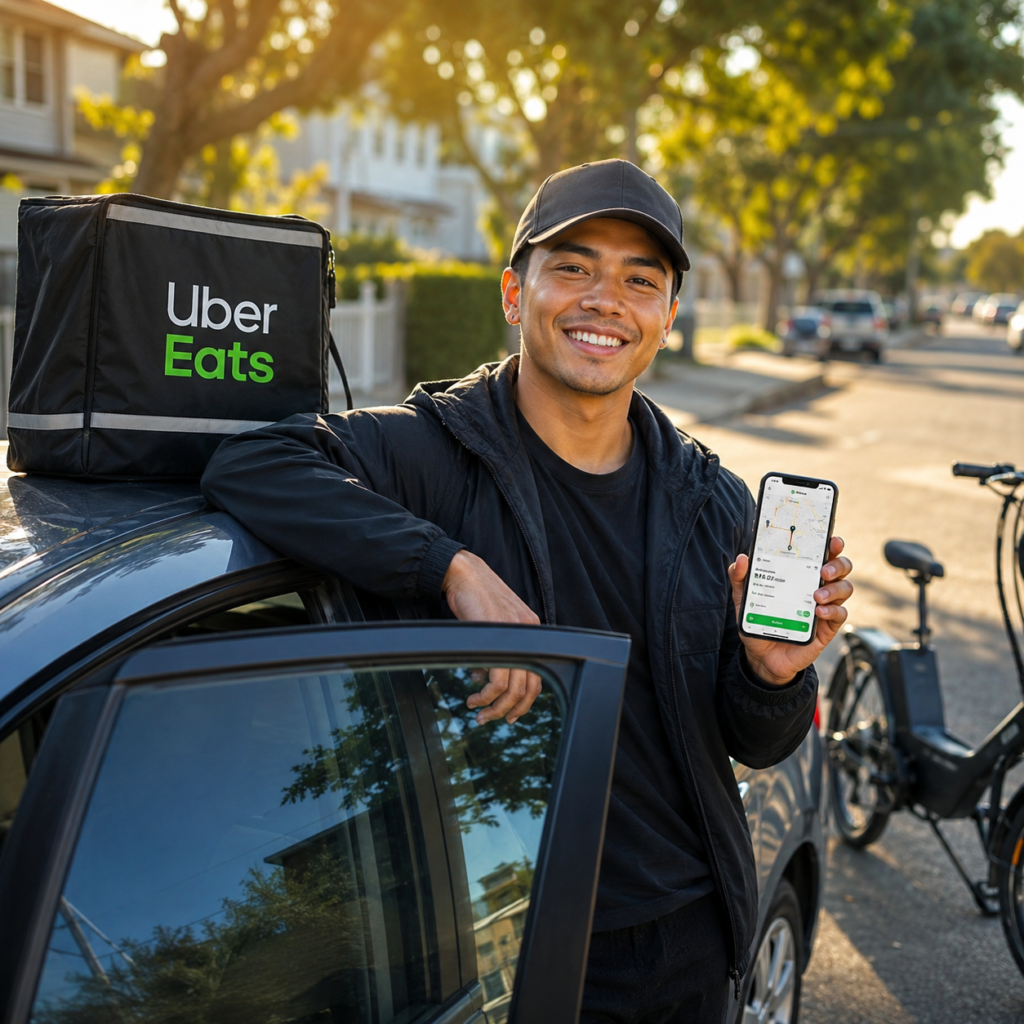
The way people earn money has changed as innovations have made everything easier. A few years ago, the idea of getting paid the same week you start a job seemed like a dream. Today, if you have a phone, a vehicle, or even just a bike in some places, and a valid driver’s license, that dream becomes real. If you’ve been typing into Google “how to sign up to be an Uber Eats driver”, you’ve landed exactly where you need to be. This is where we unwrap the secrets that those who succeed in this industry know that others do not.
What Does an Uber Eats Driver Do?
Uber Eats Drivers are the final link between restaurants and hungry customers. These drivers pick up food from restaurants and deliver it to customers, all guided through an app where delivery requests are managed. As an Uber Eats Driver, you’re not cooking the food, and you’re not taking orders by phone. Everything runs through the Uber Driver app.
Here’s a typical delivery flow and how you earn:
- You go online and open the app when you’re ready to work.
- A delivery request appears with the restaurant name, estimated pay, and the drop-off location.
- You accept it if you want it.
- You drive, bike, or walk to the restaurant, pick up the order, confirm in the app, and deliver it to the customer.
- The customer may have left a tip already or can tip after.
- Once the delivery is done, the money shows up in your Uber Eats wallet, which you can cash out up to five times a day through Uber’s Instant Pay, or you can wait for the weekly direct deposit.
In this job, you’re an independent contractor, not an employee. That means you set your own schedule and work on your own time, use your own vehicle, and handle your own taxes. The app doesn’t take taxes out of your pay. You’ll get a 1099-NEC form at tax time if you earn over $600 in the US. This setup isn’t for everyone, but it’s one of the most flexible ways to earn money right now.
One update in 2026 worth knowing is that Uber has expanded its “Uber Eats Walker” and e-bike delivery programs into more mid-sized cities, not just massive downtown areas. So even if you don’t own a car, there’s a good chance you can still sign up and earn. We’ll cover those vehicle options next.
How Do You Sign Up to Be an Uber Eats Driver in 2026?
Now let’s get to the more interesting part. You must be thinking, “Just tell me how to apply for Uber Eats driver and get moving.” This section is for you. The signup process hasn’t changed massively over the years, but the app experience and background check speed are smoother now than ever.
Here’s exactly how to sign up for Uber Eats as a driver in 2026. Follow these steps carefully, and you could be ready to deliver in just a few days.
Step 1: Create an Uber account and log in
To begin with, you’ll need the Uber Driver app, which is separate from the regular Uber app. This app is specifically for the drivers, and you can download it from the Apple App Store or Google Play Store. If you already use Uber as a rider, you can use the same login, but you’ll still need to complete the driver signup.
Step 2: Tell the app you want to deliver, not drive people.
When you sign up, Uber will ask whether you want to transport passengers or deliver food. Select “Deliver food” — that’s Uber Eats. This keeps the requirements simpler. You won’t need a special commercial license or a newer vehicle to sign up for this.
Step 3: Provide your personal details.
Enter your full legal name as it appears on your ID, date of birth, and Social Security number if you’re from the US. This is to enable the employing team to check your background. If you’re an international student with a valid work permit or an immigrant with an Employment Authorisation Document, you’ll enter those details accordingly. The system has improved in 2026 with better innovations which guide you through acceptable document types and other requirements.
Step 4: Upload your documents.
You’ll need photos of:
- Your driver’s license
- Proof of vehicle insurance, if you are using a car.
- A clear profile photo
If you’re delivering by bike or scooter, you won’t need to upload insurance or vehicle registration. Right now, Uber also accepts a growing list of e-bike and moped insurance policies where required locally.
Step 5: Consent to the background check.
This part is straightforward. Uber uses a third-party company to look at your driving record and criminal history to determine your eligibility. Most people get results within 24 to 72 hours. Sometimes it’s same-day. We’ll talk about how to speed this up later.
Step 6: Add a payment method.
You must add a bank account or Uber Pro Card details to get paid. The Uber Pro Card, which is a relaunched debit card integrated with the app, allows you to get paid after every delivery with zero cash-out fees. It’s optional but widely used among drivers for a more flexible and convenient cash-out.
Step 7: Wait for approval.
Once your background check is clear and your documents are verified, you’ll get an email update and a push notification. Then you can log in, set your availability, and start accepting deliveries. Many new drivers report being activated in under 48 hours.
That’s it. No interview. No boss. No minimum hours. If you’re ready to move forward, the app will walk you through each screen.
Practical Steps:
It might also interest you to review our carefully articulated list of Remote Jobs Hiring in the USA with No Experience Needed
What Are the Requirements to Sign Up for Uber Eats Driver Jobs?
To help you understand what you need to become an Uber Eats Driver in 2026? Make sure you check every box below before you sign up. The rules are simple, but a surprising number of applications get rejected because of some little avoidable mistakes. Check the following
Minimum age:
- Be 18 years or older for car, scooter, or bike deliveries in the US.
- Be 21 or older if you want to deliver alcohol in certain states.
Driver’s license:
- You must have a valid US driver’s license if you’re using a motor vehicle. If you’re on a bike or walking, you may not need any license at all — just a government-issued ID.
Vehicle requirements:
- Car: Must be a 2-door or 4-door vehicle in acceptable condition. No commercial branding. In 2026, there’s no maximum vehicle age for food delivery in most cities — an old but reliable car works fine.
- Scooter: 50cc or larger, with valid registration and insurance where required by state law.
- Bicycle or e-bike: No registration or insurance needed in most places. Uber encourages e-bikes because they’re faster and expand how many orders you can do.
- Walker: Still available in selected busy downtown areas. All you need is a smartphone and a valid ID.
Insurance:
- If you want a car and scooter delivery, you need personal auto insurance that meets your state’s minimum liability requirements. Uber provides supplemental insurance only when you’re on an active delivery. You don’t need commercial insurance.
A common worry is “Will my personal insurance find out?” — most drivers report no issues with this, but it’s smart to inform your insurer. Right now, some insurers even offer affordable “delivery endorsement” add-ons.
Smartphone:
- You must have an iPhone with iOS 15 or higher, or an Android phone running version 8.0 or higher. The Uber Driver app is well-optimised now, and it works smoothly on budget devices. All you need to do is subscribe to a data plan, because Wi-Fi-only won’t work on the road.
Background check:
- Uber reviews your motor vehicle record and criminal background. Minor traffic violations usually aren’t a problem. Major offences, recent DUIs, or violent crimes will result in rejection. International applicants may need to provide additional documentation depending on their visa type, but many students and Green Card holders successfully sign up.
Document readiness:
- Ensure you have clear, legible scans or photos, as blurry images are a leading cause of delays in the application process.
A quick pro tip: use a scanner app on your phone instead of just snapping a picture in poor light.
If you meet these requirements, your approval will likely be smooth. If anything seems borderline, don’t panic — the app will tell you exactly what’s missing and how to improve it.
How Much Do Uber Eats Drivers Make?
This is the question everyone asks, and the honest answer is that what you earn depends on how hard you work. There’s no single hourly rate. But we can paint a clear picture so you know what to expect before your first delivery.
In 2026, Uber Eats pay is made up of:
- Base fare: A small flat fee per delivery, which varies by distance, time, and city.
- Trip supplement: Sometimes added when a delivery is farther or takes longer than expected.
- Tips: 100% of tips go to the driver. In the US, most customers tip through the app. Tip amounts can make or break your hourly average.
- Promotions: Uber regularly offers “Quests”, which are extra money for completing a certain number of deliveries in a set period, and “Boost” zones, which offer higher per-delivery rates in busy areas.
On the ground, many drivers in 2026 report earning between $15 22 per hour before expenses, during typical lunch and dinner rushes. In high-cost cities like New York, San Francisco, or Chicago, it’s not unusual to see drivers averaging $25+ per hour on a good night. While in small towns, it’s often closer to $14–$17 per hour. Drivers who work only during peak hours earn more per hour than those spreading their hours across the whole day.
Remember: your earnings are pre-expenses. You’ll pay for your own gas, vehicle maintenance, and self-employment taxes. Despite that, drivers who work smart — cherry-picking higher-paying orders and maximising tips — often walk away with more take-home pay than a part-time minimum wage job.
If you’re still on the fence, start by testing the waters a few evenings a week. You’ll quickly learn what works in your area.
Uber Eats vs DoorDash: Which One to Choose?
Most applicants often ask to decide which option is better between Uber Eats and other platforms like DoorDash; I will soon make a separate, comprehensive post on DoorDash delivery driving. Meanwhile, the table below provides a quick summary of both, with a clear landscape to compare the options. But to make the best choice, you need to understand what these differences actually feel like when you’re out on the road. Let’s break it down.
| Feature | Uber Eats | DoorDash |
|---|---|---|
| Signup time | 1–3 days, often faster with good documents | As fast as same-day in many markets |
| Schedule flexibility | Go online anytime you want, and work on what you schedule | “Dash Now” when busy; otherwise, schedule shifts |
| Pay structure | Base fare + trip supplement + tips + promotions | Base pay + peak pay + tips |
| Tip visibility | The tip usually shows after delivery, sometimes estimated before | Total pay shown before you accept, including tip |
| Vehicle options | Car, scooter, bike, e-bike, walker | Car, bike, e-bike, scooter, and walking |
| Market reach | 6,000+ US cities; also available in many international cities | Predominantly the US, Canada, and Australia; expanding slowly internationally |
| Best for beginners | Good; less scheduling pressure | Excellent; upfront pay makes earnings more predictable |
| Tipping culture | Customers tip in-app; post-delivery tipping is common | Customers tip prominently during checkout; pre-tip shown |
Which one should you start with?
Consider DoorDash if you live in a bigger city and want a quicker sign-up process; this option can offer same-day approval. But if you prefer absolute schedule freedom with zero need to book time slots, Uber Eats wins without debate. Neither is a bad choice, and many drivers use both simultaneously to maximise earnings.
Apply to both platforms now so you can pick the best orders from day one. The signups are free, and there’s no penalty for being active on multiple apps.
Is Uber Eats Worth It in 2026?
This is a real question that is worth asking. And to be honest, you’ll have good days with multiple orders to choose from, and you’ll have slow Tuesday afternoons where you stare at your phone waiting for a ping. Whether this gig is worth your time comes down to your personal situation.
Let’s break it down honestly.
The good stuff:
- You have little to no barriers in getting an Uber Eats driving job: No resume, no interviews, no boss. If you can follow the app directions, you can do this job.
- With options like Uber’s Instant Pay, you can cash out multiple times a day as soon as you earn. That’s life-changing when you’re between paychecks.
- You work when you want. Students attend class during the day and deliver in the evening. Parents deliver during school hours.
- As mentioned, many drivers in 2026 average $15 $22+ an hour before costs. That’s above many entry-level retail jobs.
The challenges:
- Vehicle costs like gas, oil changes, tyres, and depreciation are all on you. So if you drive 100 miles a day, those costs add up. Smart drivers track mileage because every mile is deductible at tax time. The 2026 standard mileage rate helps, but you must plan for maintenance.
- As an independent contractor, you’ll owe self-employment tax plus income tax. Put aside roughly 25–30% of your net earnings so you’re not caught off guard during tax filing.
- No professional benefits like health insurance, no paid time off or vacation packages. This isn’t a traditional job. Many drivers treat it as a side hustle alongside a job that provides benefits.
- Another challenge you must notice is the inconsistent income. Some weeks are fantastic. Some are not. That’s the gig economy reality.
So, is it worth it? As a side hustle or a temporary main income while you figure out your next step, absolutely. As a full-time permanent career, it can be harder to sustain in the long term. Many drivers use delivery work as a bridge: to pay rent while job hunting, to build savings for a goal, or to supplement a 9-to-5.
Your phone and a few documents are all you need to get started this week. The cost to try it is near zero. If you treat it like a small business — tracking your earnings, expenses, and best working hours — you’ll be miles ahead of people who just wing it.
Common Reasons Applications Get Rejected
Not everyone gets approved instantly when they sign up. Here’s what trips up new applicants, so you can avoid the same mistakes.
- A recent serious driving violation, like DUI, or certain criminal offences, will cause a rejection. In 2026, Uber Eats is leaning toward stricter safety standards for obvious reasons. However, older, minor issues often clear. If you get rejected, you’ll typically receive an adverse action notice explaining why and how to dispute inaccuracies.
- Submitting expired or invalid documents will get your application flagged. Blurry photos of your ID or insurance card are the number one reason for delays. Always scan or take photos in natural daylight.
- If your name isn’t on the insurance card, or the policy number is unreadable, the system kicks it back. Make sure your documents clearly show your name, the vehicle, and the effective dates.
- The name on your driver’s license must match the name on your Uber account exactly. Mismatched information causes delay or rejection. Middle names, abbreviations, or nicknames cause mismatches.
- Applying in a market with no openings. For instance, DoorDash occasionally places new applicants on a waitlist in oversaturated areas. If this happens, check neighbouring zones or reapply later. Uber Eats rarely waitlists, but in small towns, delivery volumes might be low.
If your application hits a snag, don’t panic. Both platforms give you a chance to fix issues and resubmit.
Tips to Get an Uber Eats Driving Job Faster
Here’s how to go through the signup process with ease and no complications.
- Have all documents ready before you start. Get your license, insurance card, and a clear headshot saved on your phone. This avoids the “start-and-stop” of hunting for papers mid-application.
- Use a scanner app or good lighting. Lay documents flat on a dark surface. Avoid shadows. Make sure all four corners are visible. Tiny efforts here cut days off approval time.
- Use your exact legal name. Even if you go by “Mike,” but your license says “Michael,” put Michael. Inconsistencies trigger manual reviews.
- Check your email frequently. Approval emails sometimes land in spam, so always check there. Gmail users should check the Promotions tab as well. Missing an email asking for a document re-upload adds delays.
- Apply during the weekday morning. This is important because background check companies often process faster during business hours. So, submitting on a Saturday night might add a day.
- If your application is delayed or waitlisted, just like DoorDash does, try a neighbouring zone. Some drivers apply in the next city over, where demand is higher, and then switch their starting location after approval.
Many new drivers report being on the road in under 48 hours when they follow these steps. If you’re looking for a sign-up with minimal friction, DoorDash often takes just a day to approve, while Uber Eats might take a little longer, but it rarely has waitlists.
Turn Your Free Hours Into Extra Cash
In 2026, becoming a delivery driver is genuinely one of the most straightforward ways to start earning money on your terms. Whether you need a flexible side hustle, a gap-filler between jobs, or extra money for a specific goal, both Uber Eats and DoorDash welcome new drivers with a quick, app-based signup.
You now know how to sign up to be an Uber Eats driver, exactly what’s required, and how DoorDash’s process compares. The information is fresh, and the steps are clear. Your first delivery could be just a few days — sometimes even hours — away. Apply to both platforms, track your results, and see which one fits your schedule and your city best.
The gig economy isn’t perfect, but it puts earning power directly in your hands. And for millions of people, that’s made all the difference.