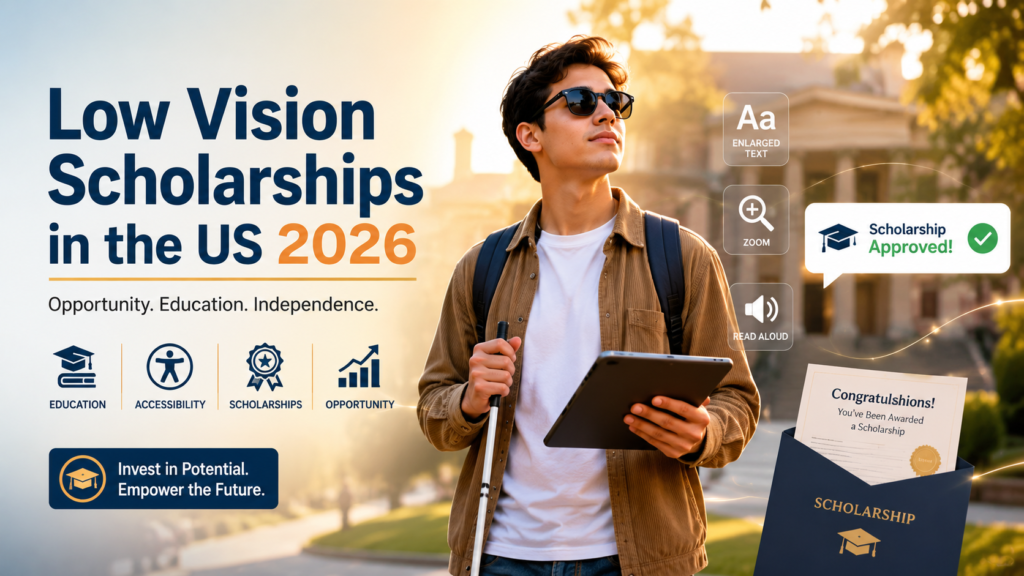
Low vision is a visual impairment that cannot be fully corrected with glasses, contact lenses, medication, or surgery. It affects daily activities such as reading, driving, or recognising faces.
The cost of higher education for students with low vision goes beyond tuition and fees. Because when you add the cost of assistive technology, plus other specialised medical attention they need, the price can go through the roof. Therefore, through the provision of public and private funding opportunities, with other features like reduced course loads and scholarships for students with low vision, it offers a unique set of financial demands that standard aid packages often fail to address.
In 2026, a growing number of scholarships are specifically designed to bridge this gap and help alleviate the financial burden on millions of students. Collectively, many organisations across the United States are awarding hundreds of thousands of dollars through low-vision scholarships. This opportunity offers special funding that is reserved for students who are blind or visually impaired.
In this article, you will find a curated list of major scholarships in this category, along with their detailed eligibility requirements, required documentation, and a step-by-step application process to help you stand out. At the end, you will be equipped with the right information needed to identify, apply for, and secure funding for your education.
What Is Low Vision?
Low vision is a visual impairment that cannot be fully corrected with glasses, contact lenses, medication, or surgery. It affects daily activities such as reading, driving, or recognising faces.
It is essential to understand how organisations define “low vision.” Most scholarships for visually impaired students in the USA require specific medical documentation, so knowing the official definitions will save you time.
Types of Scholarships Available for Low Vision Students
Not all scholarships are created equal. Here is a breakdown of the main categories you will encounter when searching for low vision scholarships in the US in 2026.
1. National Nonprofit Scholarships
Large organisations like the National Federation of the Blind (NFB) and the American Council of the Blind (ACB) offer substantial awards to students nationwide.
2. State-Funded Grants and Tuition Waivers
Many states provide grants specifically for residents with visual impairments. Examples include Pennsylvania’s Blind or Deaf Higher Education Beneficiary Grant and Florida’s Family Empowerment Scholarship.
3. University-Specific Scholarships
Colleges and universities often have internal funds for students with disabilities. The California State University system, for instance, offers the Dale M. Schoettler Scholarship for visually impaired students.
4. Career-Focused Awards
Some scholarships target students pursuing specific fields like rehabilitation teaching, orientation and mobility, or STEM disciplines.
5. Community and Religious Organisation Scholarships
Local Lions Clubs, Jewish organisations, and other community groups frequently offer smaller but less competitive awards.
Top 15 Low Vision Scholarships in the US 2026
Below is a curated list of major scholarships for students with low vision or legal blindness. Each entry includes the official application link, eligibility requirements, award amount, and deadline.
1. National Federation of the Blind (NFB) Scholarship Program
| Award Amount | Deadline | Eligibility |
|---|---|---|
| 30 awards, ranging from $3,000 to $12,000 | March 31, 2026 | Legally blind in both eyes; US resident; 18+ by July 3, 2026; pursuing or planning to pursue a full-time post-secondary degree at a US institution |
The NFB Scholarship Program is one of the most well-known and generous low vision scholarships in the US in 2026. The program awards over $250,000 annually to blind students nationwide. Finalists receive assistance to attend the NFB National Convention, where winners are announced.
How to Apply: Visit www.nfb.org/scholarships, read the rules and submission checklist, complete the official 2026 application form, supply all required documents, and schedule an interview with your local NFB affiliate president.
→ Apply for the NFB Scholarship Program
2. American Council of the Blind (ACB) Scholarship Program
| Award Amount | Deadline | Eligibility |
|---|---|---|
| $2,000 – $7,500 | February 14, 2026 | Legally blind; 3.0 GPA minimum; full-time or part-time; community involvement |
Since 1982, ACB has helped students who are legally blind pursue their educational and career goals. In 2025, ACB awarded over $111,400 to 24 students.
How to Apply: Applications for the 2026-2027 school year can be submitted online from November 1, 2025, to February 14, 2026. Visit the ACB scholarship page for the application form.
→ Apply for the ACB Scholarship Program
3. CCLVI Scheigert Scholarship
| Award Amount | Deadline | Eligibility |
|---|---|---|
| $3,000 (multiple awards) | February 15, 2026 | Low vision (not legally blind); full-time undergraduate or graduate; strong GPA; community involvement |
The Council of Citizens with Low Vision International (CCLVI) award specifically targets students with low vision, distinguishing it from many other scholarships that require legal blindness.
How to Apply: Visit https://cclvi.org/scheigert to access the guidelines and online application. Applications are available from January 1 to February 15, 2026.
→ Apply for the CCLVI Scheigert Scholarship
4. American Foundation for the Blind (AFB) Scholars Program
| Award Amount | Deadline | Eligibility |
|---|---|---|
| Up to $20,000 for undergraduate | February 17, 2026 | Legally blind; 3.0 GPA; full-time or part-time; community engagement |
The newly expanded AFB Scholars Program empowers blind students to serve as change agents in creating a more inclusive world. The scholarship is available for graduate and undergraduate students who meet the qualifications for legal blindness.
How to Apply: Applications open on January 6, 2026 and close on February 17, 2026. Visit the AFB Scholars Program page to apply.
→ Apply for the AFB Scholars Program
5. Dale M. Schoettler Scholarship for Visually Impaired Students
| Award Amount | Deadline | Eligibility |
|---|---|---|
| $10,000 | Year-round applications | Visually impaired student enrolled at any CSU campus; 2.8 GPA minimum; enrolled in 6.1+ units |
This California State University system-wide scholarship supports visually impaired students across all 22 California State University campuses. Established in 1991 by Dale M. Schoettler, a successful businessman who was blind for the last eight years of his life, the program now benefits students system-wide through a bequest from his estate.
How to Apply: CSU students who meet the requirements must complete the CSU Foundation application. Application links are distributed through each campus’s financial aid office. Students are accepted on a year-round basis.
→ Apply for the Dale M. Schoettler Scholarship
6. The Nathan L. and Suzanne K. Wolfson Fund Merit Award
| Award Amount | Deadline | Eligibility |
|---|---|---|
| $2,500 – $15,000 | Open for 2026-2027 | Jewish students with low vision or legal blindness, undergraduate or graduate, attending an accredited US college |
Since its inception, this fund has awarded nearly $500,000 to blind and low-vision Jewish students. The program recognises academically exceptional Jewish students who are legally blind or have significant vision impairments.
How to Apply: Applications for the 2026-2027 cycle are now open. Visit the Jewish Education Loan Fund (JELF) website to apply.
→ Apply for the Wolfson Merit Award
7. Kenneth Jernigan Scholarship for the Blind
| Award Amount | Deadline | Eligibility |
|---|---|---|
| Multiple awards totalling over $120,000 | March 31, 2026 | Legally blind in both eyes; US resident; 18+ by July 3, 2026; pursuing full-time post-secondary degree at US institution |
This scholarship recognises achievement by blind scholars and creates opportunities for all blind people. Applicants do not have to be US citizens but must be residing in the United States, the District of Columbia, or Puerto Rico.
How to Apply: This scholarship is part of the NFB Scholarship Program. Students need only apply once through the NFB scholarship application to be considered for the Kenneth Jernigan Scholarship and other NFB awards. Visit www.nfb.org/scholarships to apply.
→ Apply for the Kenneth Jernigan Scholarship
8. Paul and Ellen Ruckes Scholarship
| Award Amount | Deadline | Eligibility |
|---|---|---|
| $2,000 | April 2026 | Legally blind; US citizen; undergraduate or graduate student majoring in engineering, computer science, physical sciences, or life sciences; full-time enrollment |
This award supports students pursuing degrees in STEM fields, combining disability funding with academic merit. Applicants must have a minimum 3.0 GPA.
How to Apply: Based on previous application cycles, the scholarship is expected to reopen in February 2026. Application requirements include an essay, a recommendation letter, an official transcript, and proof of legal blindness.
→ Apply for the Paul and Ellen Ruckes Scholarship
9. Microsoft Disability Scholarship
| Award Amount | Deadline | Eligibility |
|---|---|---|
| $20,000 | March 16, 2026 | High school senior with a disability; planning to enrol in full-time or half-time undergraduate study at an accredited US college or vocational school; pursuing business, computer science, pre-law, or related fields |
The Microsoft Disability Scholarship helps high school students with disabilities pursue higher education and target careers in the technology industry. International students are eligible to apply if enrolling in a US college or university.
How to Apply: Submit a complete application including a cover letter, resume, letter of reference, and an essay of 750 to 1,000 words. The deadline is March 16, 2026, at 3:00 PM Central Time.
→ Apply for the Microsoft Disability Scholarship
10. CSU Nathaniel R. and Valerie Dumont Scholarship
| Award Amount | Deadline | Eligibility |
|---|---|---|
| Up to $4,000 | Varies by campus | Full-time undergraduate at an eligible CSU campus; 2.8 GPA minimum; financial need (FAFSA required); preference to visually or physically impaired students |
Established through a bequest in 1993, this scholarship assists students with financial needs, especially those with visual or physical impairments.
How to Apply: Submit the application through your campus financial aid office. Required materials include personal information, academic transcripts, a personal statement, and letters of recommendation (one from an academic instructor).
→ Apply for the CSU Nathaniel R. and Valerie Dumont Scholarship
11. Newcombe Scholarships for Students with Disabilities
| Award Amount | Deadline | Eligibility |
|---|---|---|
| Varies | Contact partner institutions | Students with disabilities needing financial assistance, enrolled at selected partner colleges and universities |
The Newcombe Foundation partners with specific US institutions that welcome and support students with disabilities. These scholarships support the completion of degrees by students with disabilities who need financial assistance.
How to Apply: Individual students may not apply directly to the Foundation. Students interested in applying for a Newcombe Scholarship should contact their institutional financial aid or scholarship office to determine if their school is a partner institution.
→ Apply for Newcombe Scholarships (contact your college financial aid office)
12. Florida Council of the Blind (FCB) Scholarships
| Award Amount | Deadline | Eligibility |
|---|---|---|
| Total program: $7,250 | March 1, 2026 | Florida resident; blind or visually impaired; enrolled in academic, professional, or technical training beyond high school |
FCB offers multiple awards to exemplary Florida students. Recipients are not required to attend college in Florida.
How to Apply: Visit the FCB Scholarship Application page. For more information, contact FCB-Scholarships@fcb.org or call 407-425-9200.
→ Apply for Florida Council of the Blind Scholarships
13. Pennsylvania Blind or Deaf Higher Education Beneficiary Grant (BDBG)
| Award Amount | Deadline | Eligibility |
|---|---|---|
| Up to $500 per academic year | March 31, 2026 | Pennsylvania resident; blind or deaf; enrolled at least half-time in a postsecondary institution; maintain satisfactory academic progress |
This state grant provides modest but accessible funding on a first-come, first-served basis. Students must qualify to receive benefits through the PA Office of Vocational Rehabilitation.
How to Apply: Download and complete the Blind or Deaf Higher Education Beneficiary Grant Application from PHEAA.org and submit it by mail or fax by March 31, 2026.
14. David M. Presley Scholarship
| Award Amount | Deadline | Eligibility |
|---|---|---|
| Varies | August 1, 2026 | Visually impaired student enrolled at or applying to North Carolina State University |
This scholarship provides support for students who are visually impaired, as defined by the CDC. Documentation from an eye specialist or the North Carolina State Disability Services Office is required.
How to Apply: New students should use the Pack ASSIST application to apply for most NC State scholarships. Once admitted, you can access Pack ASSIST and apply for scholarships. For first consideration, apply by the early action deadline of November 1.
→ Apply for the David M. Presley Scholarship (through NC State Pack ASSIST)
15. Jim Halliday HumanWare-NFB Scholarship
| Award Amount | Deadline | Eligibility |
|---|---|---|
| $1,000 + Brailliant BI40 braille display | June 1, 2026 | Blind or low vision student, aged 13 to 25; pursuing STEAM-related projects that improve accessibility or benefit communities |
This unique award combines financial aid with assistive technology, making it a valuable resource for students needing braille access. Four scholarships are awarded annually.
How to Apply: Applications are open from April 1 to June 1, 2026. The selection process takes place over one month following the application deadline, and devices will be shipped to winners in mid-August.
→ Apply for the Jim Halliday HumanWare-NFB Scholarship
Fully Funded Opportunities for Low Vision Students
Fully funded scholarships for undergraduate students with low vision are not common. However, several programs can cover a significant portion of your college costs. Some combine financial aid with academic support, while others pay for tuition, assistive technology, and living expenses in exchange for a work commitment after graduation.
Below are three of the most valuable opportunities to explore.
1. VA Visual Impairment and Orientation and Mobility Professional Scholarship Program (VIOMPSP)
The Visual Impairment and Orientation and Mobility Professionals Scholarship Program (VIOMPSP) is a federal program designed to increase the number of qualified professionals who serve veterans with visual impairments. It provides substantial financial support to students pursuing degrees or certificates in fields that help blind and low vision individuals achieve independence.
What the scholarship covers:
- Full-time students can receive up to $15,000 per academic year, with a maximum of $45,000 over four years
- VA employees may apply as part-time students
Eligible fields of study:
- Certified Visual Rehabilitation Therapist (CVRT)
- Certified Low Vision Therapist (CLVT)
- Certified Orientation and Mobility Specialist (COMS)
- Certified Assistive Technology Instructional Specialist (CATIS)
Key requirements:
- US citizen by birth or naturalisation
- Age 18 or older
- Enrolled full-time in an accredited program leading to ACVREP certification
- Must pass VA background checks and security clearance
- Cannot have an existing obligation to another federal program
In return for the scholarship, recipients must commit to a minimum of three years of service at a VA health care facility.
How to apply: Submit a complete application through the VA, including a signed written acceptance agreement.
→ Visit the official VA VIOMPSP page for more information
This is not a standard scholarship that you can use at any college for any major. It is a workforce development program. You must pursue a specific certification in visual impairment or orientation and mobility, and you must commit to working for the VA after graduation.
2. TRIO Student Support Services (SSS)
The TRIO Student Support Services program is a federally funded initiative that provides academic and personal support to students who are first-generation college students, meet federal low-income guidelines, or have a documented disability. This includes students with low vision and other visual impairments.
What the program provides:
- Academic advising and tutoring
- Financial aid and scholarship guidance
- Career exploration and transfer planning
- Peer mentoring and coaching
- Skill-building workshops
Sometimes, direct scholarship assistance is included, e.g., $500 per semester for students who complete program requirements
Eligibility criteria:
- Must be enrolled at a college that has a TRIO SSS grant
- Must meet at least one of the following: first-generation college student (neither parent graduated from a four-year college), low-income status as defined by federal guidelines, or documented disability
Key details:
- There is no cost to participate for students who qualify
- Programs are fully funded by the US Department of Education and typically run for five years
- Services are designed to help students stay in school, graduate on time, and prepare for careers or further education
How to apply:
- TRIO SSS is not a scholarship you apply for directly. Instead, you must check if your college offers a TRIO SSS program and then apply to join that program through your campus.
- Applications are typically handled through your college’s TRIO office. Some programs open applications in the spring for the following academic year.
- If your college does not have a TRIO SSS program, you will not be able to access this support.
→ Find a TRIO program near you through the US Department of Education
TRIO SSS is not a standalone scholarship. It is a support program that helps you find and secure other financial aid, and some TRIO programs offer small scholarships to participants who meet specific milestones.
3. State Vocational Rehabilitation (Voc Rehab) Agencies
Vocational Rehabilitation agencies are state-run programs that help individuals with disabilities prepare for, obtain, and maintain employment. For eligible students with low vision, Voc Rehab can cover a wide range of college-related expenses.
What Voc Rehab can cover:
- Tuition and fees
- Books and supplies
- Assistive technology such as screen readers, magnification devices, braille displays, etc.
- Transportation costs
- Sometimes, living expenses or room and board
Eligibility requirements:
- A documented disability that significantly impacts your ability to work, such as low vision or legal blindness, which qualifies in most states.
- A goal of obtaining or maintaining employment
- US citizenship or legal residency
Key details:
- Voc Rehab is often the closest thing to a “fully funded” package available for undergraduate students with disabilities.
- Financial assistance for out-of-state colleges is typically limited to in-state tuition rates unless there is a unique reason for choosing that specific institution.
- Services are individualised based on your specific needs and career goals.
How to apply:
- Contact the Voc Rehab agency in your state; often called the Department of Rehabilitation Services, Division of Vocational Rehabilitation, or Commission for the Blind.
- Schedule an intake appointment to determine eligibility.
- Work with a counsellor to develop an Individualised Plan for Employment (IPE), which outlines the services and funding you will receive.
- If approved, your counsellor will authorise funding for your approved educational program.
→ Find your state’s Vocational Rehabilitation agency
Some states have a separate agency specifically for blind and visually impaired individuals. For example, New Jersey has the Commission for the Blind and Visually Impaired (CBVI), which offers its own scholarship program for eligible clients. Always check whether your state has a dedicated blind services agency in addition to the general Voc Rehab office.
Eligibility Requirements for Low Vision Scholarships
Before applying for low vision scholarships in the US in 2026, verify that you meet these common requirements:
- Documented Visual Impairment: Most scholarships require a recent report from an ophthalmologist or optometrist confirming visual acuity or field loss.
- US Citizenship or Legal Residency: Many awards are restricted to US citizens or permanent residents, though some accept international students.
- Enrollment Status: Some scholarships require full-time enrollment (12+ credits), while others accept part-time students.
- GPA Minimums: Typically 2.5 to 3.0 on a 4.0 scale.
- Age Restrictions: Some programs, like the NFB scholarship, require applicants to be at least 18.
- Community Involvement: Many awards value leadership and service activities.
Required Documents for Your Scholarship Application
Being organised will save you stress and missed deadlines. Prepare these documents in advance:
- Medical Documentation of Visual Impairment: A signed letter from an eye care specialist stating your diagnosis, visual acuity, and/or visual field measurements.
- Academic Transcripts: Unofficial transcripts are usually accepted initially.
- Letters of Recommendation: Ask teachers, employers, or community leaders who know your character and work ethic.
- Personal Statement or Essay: Explain your educational goals, challenges you have overcome, and why you deserve the award.
- Proof of US Citizenship or Residency: Passport, birth certificate, or green card.
- FAFSA Submission Summary: Required for need-based scholarships.
- Resume or CV: List your achievements, activities, work experience, and volunteer service.
Step-by-Step Application Guide for Low Vision Scholarships
Follow this proven system to maximise your chances of winning a low-vision scholarship in the US in 2026.
1. Create a Scholarship Calendar
- List all scholarships with deadlines using a spreadsheet or calendar app
- Note the application requirements for each award
- Set reminders one month before each deadline
2. Request Medical Documentation
- Schedule an appointment with your eye specialist
- Request a detailed letter that includes specific visual acuity measurements
- Ask for multiple signed copies
3. Draft Your Personal Statement
- Write a compelling essay that connects your visual impairment to your goals
- Avoid clichés about “overcoming obstacles” – focus on specific achievements
- Have a teacher or counsellor review your draft
4. Secure Strong Letters of Recommendation
- Ask recommenders at least three weeks before deadlines
- Provide them with your resume and a summary of each scholarship
- Follow up with polite reminders
5. Complete Applications
- Submit applications early to avoid technical issues
- Double-check that all documents are uploaded correctly
- Save confirmation emails as proof of submission
6. Prepare for Interviews
- Practice answering common questions about your goals and challenges
- Research each organisation’s mission and values
- Prepare thoughtful questions to ask interviewers
With these steps, you increase your chance of getting an award once you apply strategically.
Tips to Increase Your Chances of Winning
Want to stand out among hundreds of applicants? Implement these insider strategies.
1. Apply to Less Competitive Local Scholarships
National awards like NFB and ACB receive thousands of applications. Meanwhile, local Lions Club scholarships or state-specific grants may have only dozens of applicants. Your odds increase dramatically with smaller pools.
2. Highlight Your Unique Perspective
Don’t just list your visual impairment as a challenge. Explain how it has shaped your worldview, problem-solving skills, and career aspirations. Authenticity resonates with selection committees.
3. Demonstrate Community Impact
Scholarship committees want students who give back. Document your volunteer hours, leadership roles, and service projects. Even small contributions matter.
4. Proofread Everything
Typos and grammatical errors signal carelessness. Read your application aloud, use spell-check, and ask someone else to review it before submission.
5. Apply Even If You Think You Won’t Win
Many students self-select out of applying because they assume they aren’t competitive enough. Remember: you miss 100% of the scholarships you don’t apply for.
Common Mistakes to Avoid When Applying
Avoid these pitfalls that derail otherwise strong applications for low vision scholarships in the US in 2026.
1. Missing Deadlines: Scholarship deadlines are firm. Late applications are rejected without review. Use calendar alerts and submit at least 48 hours early.
2. Submitting Generic Essays: Using the same essay for every scholarship is a recipe for rejection. Customise each essay to address the specific mission and values of each organisation.
3. Forgetting Required Documents: Double-check application checklists before hitting submit. Missing medical documentation or transcripts is a common reason for disqualification.
4. Ignoring Small Awards: A $500 scholarship might seem insignificant, but five $500 awards add up to $2,500. Apply to scholarships of all sizes.
5. Failing to Follow Instructions: If an application asks for a 500-word essay, do not submit 700 words. If it asks for a PDF format, do not send a Word document. Attention to detail matters.
Best Universities for Students with Low Vision
Some colleges and universities go above and beyond in supporting students with visual impairments. Consider these institutions when researching low vision scholarships in the US in 2026.
- University of Arizona
The Disability Resource Centre provides comprehensive accommodations, and Arizona offers tuition waiver scholarships for eligible students with disabilities.
- California State University System
All 23 CSU campuses participate in the Dale M. Schoettler Scholarship for Visually Impaired Students, providing $10,000 awards to qualified students.
- North Carolina State University
NC State’s Disability Resource Office works closely with students to provide accommodations, and the David M. Presley Scholarship supports visually impaired students.
- Stanislaus State
This CSU campus has demonstrated exceptional commitment, awarding eleven visually impaired students $10,000 each through the Schoettler Scholarship in 2026.
How to Find More Low Vision Scholarships
Use these strategies to discover additional low vision scholarships in the US in 2026 beyond this guide.
Search Engines and Databases
- BigFuture Scholarship Search (College Board): Filter by disability category
- Scholarships.com: Search for “visual impairment” or “low vision”
- AcademicWorks: Many universities use this platform for internal scholarships
Professional Organizations
- Association for Education and Rehabilitation of the Blind and Visually Impaired (AER)
- Council of Citizens with Low Vision International (CCLVI)
- Lions Clubs International (local chapters often offer scholarships)
State-Specific Resources
- Contact your state’s Commission for the Blind or equivalent agency
- Check your state’s higher education assistance website
- Search for “[Your State] blind scholarship 2026”
Frequently Asked Questions
Can international students apply for low vision scholarships in the US in 2026?
Most low vision scholarships are restricted to US citizens or permanent residents. However, some university-specific awards and private foundations accept international applicants. Always check eligibility requirements before applying.
What is the difference between “low vision” and “legally blind” for scholarship purposes?
Low vision typically refers to visual acuity of 20/70 or worse after correction. Legal blindness requires 20/200 or worse OR a visual field of 20 degrees or less. Some scholarships for visually impaired students in the USA accept both definitions, while others specifically require legal blindness.
Do I need to prove my visual impairment for every scholarship?
Yes, virtually every scholarship requires medical documentation from an ophthalmologist or optometrist. Request multiple signed copies to avoid delays.
Can part-time students apply for low vision scholarships?
Increasingly, yes. The NFB Scholarship Program now awards up to five scholarships to part-time students annually. Other organisations, like ACB, also accept part-time students who work at least 32 hours per week.
Are there scholarships specifically for graduate students with low vision?
Absolutely. Many of the scholarships listed above, including ACB, NFB, AFB Scholars Program, and Microsoft Disability Scholarship, are open to graduate students.
What if I don’t have a high GPA? Can I still win scholarships?
Yes. While many scholarships require a minimum GPA, some focus on community involvement, leadership, or specific career interests. State Voc Rehab programs often do not have GPA requirements.
How many scholarships should I apply for?
Apply for as many as you qualify for. Successful students typically submit 20–50 applications. Start with 10–15 and increase from there.
When should I start applying for 2026 scholarships?
Start in fall 2025. Many applications open between November and January, with deadlines in February, March, and April 2026.
Take Action Today
You have just reviewed the most comprehensive guide to low vision scholarships in the US 2026 available anywhere. You know where to find scholarships, how to apply, what documents to prepare, and common mistakes to avoid.
Now comes the most important step: taking action.
Start by completing your FAFSA today. Then request your medical documentation. Then choose three scholarships from this guide and begin your applications this week. Every application you submit brings you closer to an affordable college education.
Don’t let the fear of rejection stop you. Thousands of dollars in scholarships are awarded every year to students just like you. The only way to win is to apply.
Ready to start? Bookmark this page, share it with friends who need it, and begin your scholarship journey today. Your future self will thank you.