
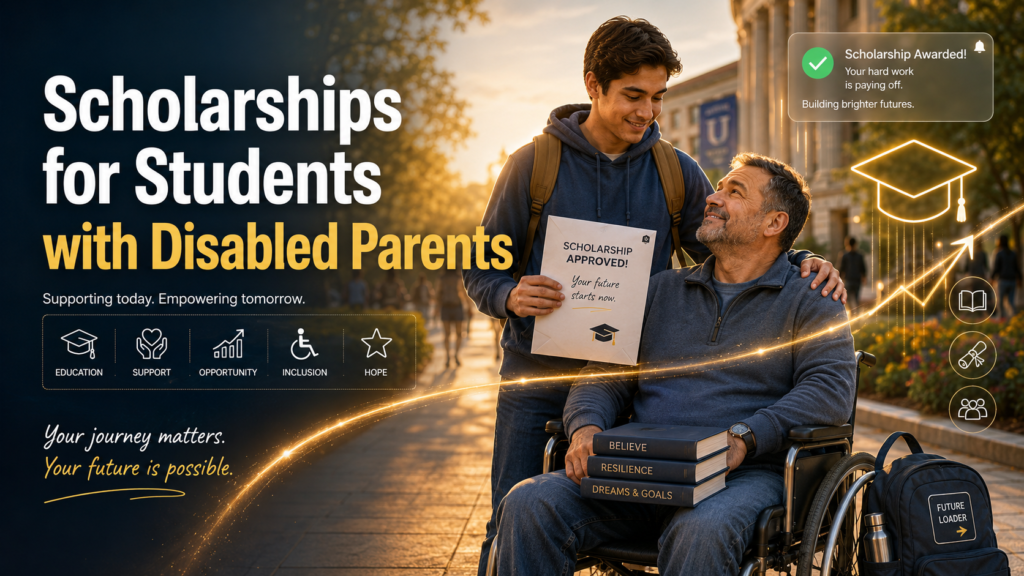
Are you searching for scholarships for students with disabled parents to help pay for college in the 2026–2027 academic year? I have some good news for you. This article carefully walks you through verified scholarships for students just like you, from the American Legion Legacy Scholarship to state‑specific tuition waivers. We will also cover expert guides on how to write a clean essay that wins such scholarships. You don’t have to worry about the tuition, and get ready to apply today.
Key Takeaways
After reading this guide, you will be able to:
- Find verified scholarships for the 2026–2027 academic year that specifically support students whose parents are disabled, from $1,000 awards to full tuition coverage.
- Maximise your federal aid by using a simple FAFSA strategy you may have overlooked, including a Special Circumstances Appeal that can reassess your financial need.
- Write a powerful personal essay that turns your family’s experience into your biggest advantage—without falling into clichés or self‑pity.
- Submit applications with confidence knowing exactly which documents you need (tax returns, disability verification, transcripts) and how to organise them.
- Avoid costly mistakes that cause most students to leave money on the table—so you can focus on college, not on how to pay for it.
Now, without further ado, let us get straight into the day’s business.
Your Journey to College Funding Starts Here
What if the hardest part of your life became the very thing that pays for your education?
Think about it. You’ve spent years being the responsible one. The helper. The one who shows up—for doctor’s appointments, for late‑night care, for the quiet moments when a disabled parent just needs someone to listen.
That weight is real. But so is the opportunity for students like you.
Because colleges and scholarship committees don’t just look at test scores. They look for students who have faced real obstacles and kept moving forward. In this case, having a parent with a disability is not a weakness in your application; it’s proof of your strength. Scholarships for students with disabled parents exist to reward the resilience you’ve already shown.
You’ve already done the hard part. Now let’s get you paid for it.
What Does “Disability” Mean for These Scholarships?
Before you start applying, you need to understand how scholarship providers define disability. While definitions vary, most rely on the Americans with Disabilities Act (ADA) framework.
Under the ADA, a disability is any physical or mental impairment that substantially limits one or more major life activities, such as walking, seeing, hearing, speaking, breathing, learning, or performing manual tasks. The law also covers a person who has a record of such an impairment or is regarded by others as having one.
For scholarship eligibility, providers may ask for:
- Official documentation, such as a doctor’s report or a VA disability rating for veterans.
- Proof of permanent and total disability, as some programs may require confirmation that the parent is unable to work again.
- Specific rating thresholds, such as some scholarships, like the American Legion Legacy Scholarship, require a 50% or higher VA rating.
Always check each scholarship’s criteria carefully and be sure of the requirements. Some accept any disability, while others focus on specific conditions like ALS, spinal cord injury, or workplace accidents
Top 10 Scholarships for Students with Disabled Parents in 2026-2027
After thorough research and careful selection, I’ve compiled the most current opportunities for the 2026–2027 academic year. Each listing includes the award details, eligibility requirements, deadlines, and direct links to official application pages. I recommend you bookmark this section because you’ll want to return to it as you prepare your applications.
1. American Legion Legacy Scholarship
- Value: Up to $20,000 for children of fallen service members; up to $5,000 for children of disabled veterans
- Deadline: March 25, 2027. Applications open annually on January 1.
- Apply here: www.legion.org/legacy-scholarship-application
The American Legion Legacy Scholarship is a need‑based opportunity fully designed to empower the children of veterans and fallen service members. This is to fill the financial gap left after you’ve exhausted all federal and state educational grants and scholarships. It covers undergraduate, graduate, and trade school programs. Meanwhile, recipients may reapply for up to six additional annual awards. High school seniors, high school graduates, and current college students are all eligible.
To be eligible for this program, you must be a dependent child of a post‑9/11 veteran with a VA disability rating of 50% or higher. VA rating is the government’s official measure of how severe a service‑connected disability is.
2. Folds of Honour Scholarship
- Value: Up to $5,000 per academic year
- Deadline: February 1 – March 31, 2026
- Apply: www.foldsofhonor.org/scholarships
The Folds of Honour Scholarship doesn’t just cover tuition — it also considers unmet financial need for housing, textbooks, and fees not covered by other aid. Awards are based on your total cost of attendance minus other assistance you’ve already secured.
To be eligible, you must be the spouse or dependent child of a U.S. service member or first responder who meets one of the following: was killed in the line of duty, has a disability caused by their service, or received a Purple Heart Medal. You also need a minimum of 2.0 GPA.
3. SFM Foundation Scholarship
- Award value: Up to $15,000 per year
- Deadline: March 31, 2026
- Apply here: www.sfmfoundation.com
This is one of the most generous renewable awards available in this category. Recipients of this scholarship can receive funding every year until they complete their degree at a two‑ or four‑year college, university, or vocational school. The funds can be used for tuition, required books, and institutional fees.
You are eligible if your parent has been disabled or fatally injured while working for an employer in Iowa, Minnesota, or Wisconsin. Also, you must be a U.S. citizen or lawful permanent resident who demonstrates financial need and be between the ages of 16 and 25. No minimum GPA is required, but a 2.0 GPA is recommended.
4. Kids’ Chance Scholarships
- Value: Varies by state
- Deadlines: Varies by state
- Visit www.kidschance.org to find your state chapter
Kids’ Chance is a network of state‑based organisations, each with its own application process and award amounts. In Pennsylvania, for example, awards are approximately $4,820. In Michigan, the program serves students ages 17‑22. Each state chapter also offers an Emergency Grant Program for urgent financial needs.
Eligible applicants are children of workers who have been killed, seriously injured, or experienced a debilitating illness in a work‑related accident. Be informed that a FAFSA completion is often required.
5. Heroes’ Legacy Scholarship
- Value: $2,000 per award
- Apply: go to myairforcebenefits.us.af.mil and search “Heroes’ Legacy Scholarship”
This scholarship honours those who died or became disabled through active Air Force service since September 11, 2001. At least one recipient is selected at each commissary location where qualified applications are received and processed, making this uniquely designed award accessible for military families worldwide.
To be eligible, you must be a child of an active duty, retired, or deceased military member. Applicants must be enrolled or planning to enrol in a full‑time undergraduate program leading to a bachelor’s degree. A minimum 2.5 GPA is required.
6. Millie Brother Scholarship
- Award value: Approximately $3,000 annually
- Application timeline: January 1 – February 28, 2026
- Apply here: www.coda-international.org
This is the only scholarship on this list that is open to students from all countries. It supports hearing children of deaf adults (CODAs) pursuing post‑secondary education at any accredited institution, including community colleges and trade schools. The scholarship can be used for undergraduate or graduate study.
To qualify for this opportunity, you must be a hearing son or daughter of deaf parents. Both high school seniors and current undergraduate students are eligible.
7. Paula Kovarick Segalman Scholarship Program
- Value: Up to $5,000, renewable for up to four years
- Deadline: June 16, 2026
- Apply here: scholarshipamerica.org/paula-kovarick-segalman-scholarship-program
Established by the Segalman family in 2016, this renewable scholarship supports students whose lives have been financially impacted by Amyotrophic Lateral Sclerosis (ALS), whether you have been diagnosed yourself, or a parent, guardian, or immediate family member has. Up to three previous recipients may receive renewal scholarships annually. A minimum 2.5 GPA is required.
To be eligible, ALS must have impacted your family’s finances. This includes your own diagnosis or that of a parent or guardian. If you already receive the #RAREis Scholarship, you are not eligible.
8. Children of Injured Workers Scholarship
- Value: $1,000
- Apply here: financialaid.uoregon.edu/children-injured-workers-scholarship
This scholarship, also known as Hoggatt Injury Law, requires you to write a 500‑ to 1,000‑word essay discussing your experiences as a child of an injured worker and how it has impacted your life. This opportunity is excellent for students who can tell a compelling personal story to express how the challenges and experiences they have had. The awarded funds can be used at any accredited college or university in the United States.
Eligible candidates are students whose parents have been affected by a work‑related injury, including death or permanent disability. As an applicant, you must be at least 18 years old, a U.S. citizen, and enrolled, or planning to enrol, in an undergraduate or graduate program at an accredited U.S. college or university. Also, you must have a GPA of at least 2.5 to qualify for this award.
9. Federal Supplemental Educational Opportunity Grant (FSEOG)
- Award value: $100–$4,000 per year
- Application Process: Complete the FAFSA as early as possible and check with your college’s financial aid office about the FSEOG priority deadline.
- For more information: studentaid.gov/understand-aid/types/grants/seog
This is the only federal grant specifically targeted at students with exceptional financial need, and parental disability often qualifies as a special circumstance. For the 2026–2027 academic year, Congress has maintained FSEOG funding at $910 million, the same as the 2025–2026 academic year. However, funds are extremely limited and awarded on a first‑come, first‑served basis. Generally, only students who file the FAFSA by their college’s priority deadline will receive FSEOG.
To qualify for this scholarship, you must be an undergraduate student with exceptional financial need. Parental disability is considered a valid special circumstance that financial aid administrators can use to adjust your FAFSA data through a Professional Judgment review.
10. Sandra West ALS Foundation Scholarship
- Award: Multiple awards available
- Deadline: June 18, 2026.
- Apply here: bold.org/scholarships/sandra-west-als-foundation-scholarship
This scholarship was created by the West family in memory of Sandra West, an elementary school teacher who placed a high value on education but was deeply affected by ALS. It specifically supports students who face the dual challenge of pursuing higher education while managing the emotional and financial impact of a parent’s ALS diagnosis.
You are eligible if you’re a child of a parent diagnosed with Amyotrophic Lateral Sclerosis (ALS), also known as Lou Gehrig’s disease, whose family is facing financial hardship. Current or prospective undergraduate or graduate students may be eligible to apply.
The FAFSA Advantage For Children of Disabled Parents
Many students don’t realise that having a disabled parent can significantly increase their eligibility for federal grants and work‑study. The key is completing the Free Application for Federal Student Aid (FAFSA).
Step‑by‑Step FAFSA Application Guide
- Create an FSA ID at studentaid.gov.
- Gather your documents, including: Social Security number, tax returns, W‑2s, and records of untaxed income such as Social Security Disability Insurance.
- Fill out the FAFSA for the academic year you plan to attend. The form uses tax data from two years prior, so for the 2026–2027 FAFSA, your family’s 2024 income is used to assess financial need.
- List your parents’ information unless you qualify as an independent student.
- Review your Student Aid Index (SAI) and be sure what it is. A negative SAI indicates the highest level of need.
The FAFSA Special Circumstances Appeal
If your parent became disabled after the tax year used on the FAFSA, the standard formula may overestimate your family’s ability to pay. In this case, you can file a Special Circumstances Appeal with your college’s financial aid office. Also known as a Professional Judgment adjustment, this process allows the financial aid administrator to modify your FAFSA data elements to reflect your family’s current financial situation.
What qualifies as a special circumstance?
- Loss of untaxed income, such as disability benefits.
- Parents’ permanent and total disability in the current tax year.
- Excessive medical expenses, for instance, if there was an over 11% of household adjusted gross income.
- Death or divorce of a parent.
What you need to provide to qualify:
- A written explanation of your family’s change in circumstances.
- Documentation: disability award letter, doctor’s statement, VA rating, or termination of employment letter.
- Copies of recent tax returns and pay stubs.
Submitting an appeal does not guarantee additional aid, but it is your best chance to have the financial aid office reassess your need. Deadlines vary by school; submit as early as possible.
Dependency Override: When You Can’t Get Parent Information
In rare cases, such as an abusive home environment or total abandonment, where you can’t get parents’ information, you may request a dependency override, allowing you to file the FAFSA without parental information. According to the FAFSA Simplification Act, unusual circumstances justify an aid administrator adjusting a student’s dependency status based on his unique situation.
Each override is decided on a case‑by‑case basis by the financial aid office. Note that dependency overrides do not automatically renew year‑to‑year, so you must request a new appeal each academic year.
How to Write a Winning Scholarship Essay
Most scholarships for students with disabled parents require a personal essay. This is your opportunity to tell your story in a way that makes the selection committee root for you.
What to Include in Your Essay
Answer each of these questions thoroughly. Do not skip any.
1. A detailed description of your parents’ disability, or state that they are deceased. Be specific but respectful. Name the condition if it is known, e.g., spinal cord injury, multiple sclerosis, severe depression, ALS, etc. Explain how it limits their daily life. Avoid medical jargon – write for a general reader.
2. How the disability has impacted your family – financially, emotionally, and practically. Financially: Lost income, medical bills, reduced work hours. Emotionally: Stress, grief, role reversal. Practically: You may have taken over chores, driving, translation, caregiving, or managing appointments.
3. Your current plan to finance your education. Mention other scholarships you’ve applied for, part‑time work, community college plans, or living at home to save costs. This proves you are responsible and not just looking for a handout.
4. The expected impact of the scholarship – how will this award change your life? Be concrete. “This $5,000 will cover my tuition for one semester, allowing me to reduce my work hours from 30 to 10 per week and focus on my engineering coursework.” Avoid vague statements like “it would mean the world to me.”
5. What are your plans after graduation, such as your career goals, further education, or how you intend to give back to the community?
Committees want to invest in students who will contribute to society. Show ambition and gratitude. For example: “After earning my nursing degree, I plan to work in a VA hospital serving disabled veterans like my father.”
Sample Essay Outline
- Start with a specific, vivid moment that captures the challenge of growing up with a disabled parent. Avoid starting with “Since I was a child…” or dictionary definitions.
- Briefly explain your parents’ disability and the family’s financial and emotional journey.
- Describe responsibilities you’ve taken on, such as caregiving and other work to help with bills, and how those experiences have shaped your character.
- Connect your struggles to a clear vision for your education and future.
- Explain exactly how the award will remove barriers and allow you to focus on your studies.
- End with a forward‑looking statement that reflects resilience, hope, and a commitment to giving back.
Real‑World Example
“Somehow in the midst of it all, you tend to forget about the things you don’t have, and appreciate what you do have. Dad has days where there is a light at the end of the tunnel; but then there are also those days where it seems there isn’t much more time. I just hope when his time comes, he knows how much he was loved. No one saw him as a failure. We saw him as a father.”
“The disease robbed my mother of everything—her marriage, her hair, time with her children, and most of all, mobility. Yet instead of surrendering, she conquered it. Her unrelenting resilience taught me to persevere in the face of adversity.”
These essays win because they are honest, specific, and show the applicant’s strength without self‑pity.
Practical Tips to Boost Your Application Success
- Complete the FAFSA immediately – even if you don’t think you’ll qualify. Many scholarships require it.
- Start early – scholarship deadlines often fall in the spring for the following academic year. Mark your calendar for March, April, and June deadlines.
- Gather all required documents – tax returns, disability verification, transcripts, and letters of recommendation. Keep digital copies in one folder.
- Request strong letters of recommendation from teachers, counsellors, or employers who can speak to your resilience and work ethic.
- Tailor each essay – don’t send a generic essay. Address the specific mission of each scholarship program.
- Don’t overlook small scholarships – a $500 award may not seem like much, but several of them can add up to cover books and fees.
- Beware of scams – never pay to apply for a scholarship. Legitimate programs will never ask for your credit card or bank account number.
Frequently Asked Questions
Do I have to prove my parents’ disability?
Most programs require official documentation, such as a VA rating letter, Social Security Disability award letter, or a physician’s statement. Keep copies ready.
Can I apply if my parents’ disability is not physical?
Absolutely. Many scholarships explicitly include mental illness, learning disabilities, and chronic medical conditions like cancer, MS, or ALS. The ADA definition covers these as well.
What if my parent became disabled after I started college?
File a Special Circumstances Appeal with your financial aid office immediately. You may be eligible for additional grants and a reassessment of your need.
Are these scholarships renewable?
Some are one‑time awards; others (like the SFM Foundation Scholarship) are renewable as long as you maintain eligibility. Always check the renewal criteria.
I’m not a U.S. citizen. Can I still apply?
Most federal and state programs require citizenship or eligible non‑citizen status. However, some private scholarships (e.g., Millie Brother Scholarship) are open to students from any country in the world.
Where can I find more scholarships?
Use free search engines like BigFuture, Scholarships360, and your college’s financial aid website. Also, contact local nonprofits, religious organisations, and community foundations.
Your Story Is Your Strength
Having a disabled parent does not define you—but it has made you resilient, compassionate, and determined. Those are exactly the qualities scholarship committees want to reward. You have already overcome more than most students your age, and that experience is not a weakness; it is your greatest asset.
Start today: fill out the FAFSA, bookmark the scholarships above, and begin drafting your essay. One application at a time, you can unlock the funding you need to pursue your education and build a brighter future for yourself and your family.
You’ve got this. Now go apply.